Japanese
Snack Bars
Japan's Living-Room Bars,
and How to Walk Into One
Somewhere on almost every street of bars in Japan there is a small sign that says スナック, a closed door with no window, and the muffled sound of someone singing. Most visitors walk past. Behind the door is one of the most distinctive institutions in Japanese nightlife, and one of the least understood.
A snack bar is not a place that sells snacks. It is a tiny bar run by a woman everyone calls mama, where the same customers have been drinking from their own labeled bottles and singing to each other for years.
This guide explains what a snack is, where the name comes from, how a visit works from the door to the bill, what it costs, how the karaoke etiquette works, and how a foreign visitor can find one and be welcomed.
What Is a Snack Bar in Japan?
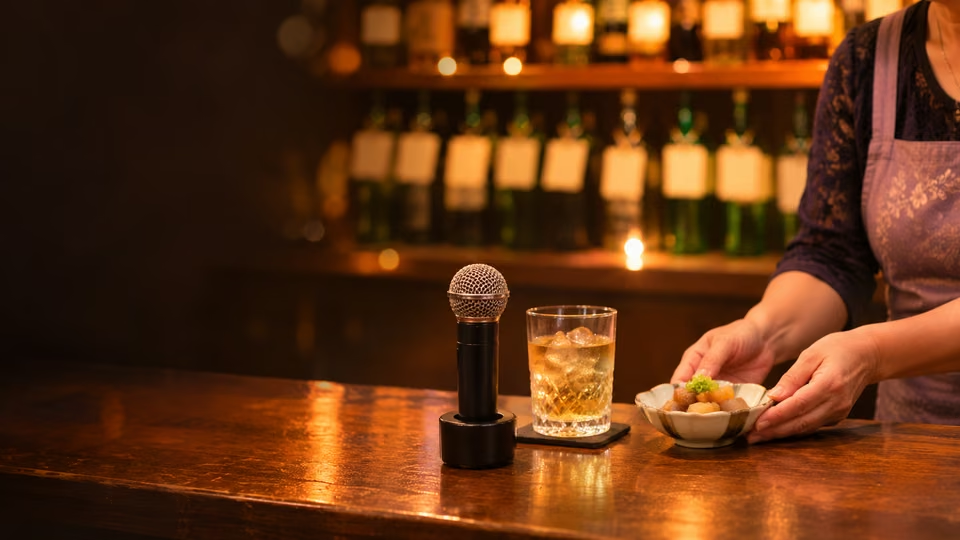
A snack bar (スナック, sunakku) is a small neighborhood bar run by a proprietress called the mama. It has nothing to do with snack food. A typical one has a counter with eight or ten stools, perhaps a sofa or two, a karaoke machine, a shelf of bottles with customers' names on them, and a mama who has been pouring drinks for the same regulars for years.
People do not go to a snack for the drinks, which are plain: whisky or shochu with water and ice. They go for the mama and for each other. A snack is closer to a living room than to a bar. Customers talk across the counter, sing in turn, and are treated as members of a small community that meets a few nights a week.
Snacks exist in every town in Japan, from the back streets of Shinbashi to fishing ports with a single traffic light. In many small towns they are the only nightlife there is.
Why Is It Called a "Snack"?
The name is a leftover from a regulation. Snack bars emerged around the time of the 1964 Tokyo Olympics, when the government tightened rules on the nightlife industry and required such venues to close at midnight.
Bars responded by serving light meals, or "snacks," alongside their drinks. That let them register as eating establishments instead of entertainment venues and stay open into the early hours. The food was never the point, and over time it shrank to a small dish of nuts or pickles. The name stayed.
This is also why the legal position of a snack differs from that of a hostess club. In a standard snack, the mama and any staff serve from behind the counter and do not sit beside customers. That distinction matters under Japan's entertainment business law, and it is what separates a snack from a kyabakura.
Inside a Snack: The Parts That Make It Work
01.The mama (ママ)
The owner, manager, bartender, and reason the place exists. Many mamas are in their fifties or older and have run the same bar for decades. A good mama remembers every regular's drink, job, and family news, steers the conversation so nobody is left out, and decides who is welcome. Customers are loyal to her, not to the premises. Male owners exist too and are called master.
02.The counter
Almost everything happens at the counter. Sitting side by side, facing the mama, puts strangers into the same conversation within minutes. This is the main difference in feel from a hostess club, where each table is its own private world.
03.Bottle keep (ボトルキープ)
Regulars buy a full bottle of shochu or whisky, write their name on a tag, and leave it on the shelf. On later visits they pay only the set charge and drink from their own bottle. The wall of tagged bottles is the snack's membership list.
04.Karaoke
Nearly every snack has a karaoke machine, and singing is part of the social contract. Songs are sung to the whole room, one customer at a time, and everyone applauds. Showa-era pop and enka ballads dominate, though any song is welcome.
05.The otoshi (お通し)
A small dish served when you sit down: dried snacks, pickles, or something the mama cooked that afternoon. It is included in the charge and is the last trace of the "light meal" that gave snacks their name.
06.The regulars (常連)
A snack's customers are mostly locals who come weekly. They greet each other by name, pour each other's drinks, and will usually draw a newcomer into the conversation. Their presence is why a snack can feel closed from outside and warm once you are in.
Snack vs Hostess Club vs Girls Bar vs Bar
| Snack | Hostess club | Girls bar | Regular bar | |
|---|---|---|---|---|
| Who runs it | A mama | A manager, with a hostess roster | Young female staff | A bartender |
| Where staff are | Behind the counter | Seated beside you | Behind the counter | Behind the counter |
| What you pay for | Company and community | One-to-one attention | Casual chat | Drinks |
| Typical bill | ¥3,000–¥7,000 | ¥8,000–¥30,000 | ¥3,000–¥8,000 | Per drink |
| Karaoke | Almost always | Sometimes | Sometimes | Rarely |
| Atmosphere | Homely, local | Polished, private | Light, young | Varies |
| Typical customer | Local regulars, 40s and up | Businessmen, groups | Younger men | Anyone |
For the other formats, see What Is Kyabakura?, the girls bar guide, and the Japan hostess club guide.
How a Visit Works
Finding the door
Snacks are easy to miss. Look for a small illuminated sign with スナック and a name, often a woman's name, on the ground floor or upper floors of a narrow building. The door is usually solid, with no window. This is normal and does not mean the bar is closed or private.
Going in
Open the door, say konbanwa (good evening), and hold up fingers for the number in your party. If the mama has room and is happy to take a first-timer, she will wave you to a stool. If she says the bar is full or members-only, thank her and try the next one. It is not personal.
Asking the price
Before you sit, ask ikura desu ka? (how much is it?) or show a translation app. The mama will tell you the set charge and what it includes. Asking is ordinary and expected from a first visitor.
The first drink
You will get a hot towel, the otoshi, and a drink from the house bottle, usually whisky or shochu mixed with water (mizuwari) or soda. The mama or a neighbor will keep your glass topped up.
Talking
Expect questions: where you are from, what you are doing in town, what you eat at home. The whole counter will listen to the answers. A few words of Japanese and a translation app go a long way here.
Singing
Sooner or later the karaoke remote will reach you. Pick something, even a short and simple song. Trying matters more than singing well, and a foreign visitor singing anything at all usually delights the room.
Offering the mama a drink
It is customary to offer the mama a drink at some point: mama mo ippai dōzo. She will pour herself something small and add it to your bill. One is enough.
Paying
When you are ready to leave, say okaikei onegaishimasu. The bill is usually a single handwritten number. Pay in cash; many snacks do not take cards. The mama will often see you to the door.
What a Snack Costs
| Item | Typical price | Notes |
|---|---|---|
| Set charge | ¥3,000–¥5,000 | Covers seat, otoshi, and drinks from the house bottle, often for 60–90 minutes or with no time limit |
| Karaoke | Free to ¥200 per song | Some snacks include unlimited karaoke in the set |
| Drink for the mama | ¥500–¥1,000 | Customary, once or twice |
| Bottle keep: shochu | ¥3,000–¥6,000 | Kept for you for three to six months |
| Bottle keep: whisky | ¥5,000–¥12,000 | Depends on the brand |
| Return visit with your own bottle | ¥2,000–¥3,500 | Set charge only, plus ice and mixers |
| Typical first visit, total | ¥4,000–¥7,000 | One person, about two hours |
Karaoke Etiquette
Take turns. Enter one song at a time and wait for the queue to come around. Entering three in a row is the fastest way to lose the room.
Applaud everyone. Clap at the end of every song, including bad ones. People will do the same for you.
Do not sing a regular's signature song. Regulars often have an ohako, a song that is known as theirs. If someone mentions that a song belongs to a particular customer, pick another.
Duets are an invitation. If the mama or a neighbor asks you to sing a duet, say yes. It is a gesture of welcome.
Keep it short and familiar. Long album tracks and obscure songs test the room's patience. Well-known English songs work well: the Beatles, Carpenters, Queen, and Disney songs are in every machine and known to every customer.
Dos and Don'ts
01.Do greet the room
Say good evening when you enter and good night when you leave, to the mama and to the counter in general. A snack is a shared space.
02.Do talk to your neighbors
Conversation across the counter is the point. Pouring a neighbor's drink when their glass is low is a friendly gesture and will be returned.
03.Do bring cash
Many snacks are cash only. Carry at least ¥10,000.
04.Don't flirt with the mama or staff
Warmth is part of the service, and it stops there. A snack is not a hostess club, and it is certainly not anything more. Physical contact is out of the question.
05.Don't photograph other customers
Regulars come to relax among people they know. Ask the mama before taking any photo, and keep other customers out of the frame.
06.Don't overstay when it's busy
If regulars arrive and the counter is full, finishing your drink and making room is appreciated, and remembered on your next visit.
Can Foreigners Go? Can Women Go?
Foreign visitors: yes, though the welcome varies by bar. Some mamas turn away anyone they do not know, Japanese or foreign, a practice called ichigen-san okotowari (no first-timers). Others are delighted by a new face. A polite greeting at the door, a smile, and a translation app are usually enough. Arriving with a Japanese speaker or a regular makes entry almost certain.
Language: most mamas speak little English. That matters less than you might expect. Karaoke needs no translation, and regulars often produce more English than they first admit to.
Women: yes. Snack customers have historically been middle-aged men, but women are welcome at most snacks, alone or in groups, and younger women rediscovering snacks have become a recognized trend in Japan. A snack with a female mama is one of the easier places in Japanese nightlife for a woman to drink alone.
Guided visits: if walking into an unmarked door feels like too much, several operators in Tokyo run snack bar tours with an English-speaking guide who handles the introductions. It is a reasonable way to make a first visit, after which going alone is much easier.
Where to Find Snacks
01.Tokyo
Snacks are thickest in the older, working districts: Shinbashi and the edges of Ginza, Ueno and Yushima, Asakusa, Kinshicho, and the back streets of Kabukicho. Residential neighborhoods along any train line usually have a handful near the station.
02.Osaka
Kitashinchi has upscale snacks alongside its clubs. Minami, Kyobashi, Juso, and Tennoji have cheaper, livelier ones where the mama's banter is half the entertainment.
03.Sapporo
Susukino has an unusually dense snack culture, a product of long winters and small-town roots. Many have run for decades. See the Susukino guide.
04.Fukuoka
Nakasu and Tenjin both have many snacks tucked into the upper floors of entertainment buildings. See the Fukuoka guide for the districts.
05.Regional cities
This is where snack culture is strongest. Entertainment districts such as Nagarekawa in Hiroshima, Kokubuncho in Sendai, Shimotori in Kumamoto, and Shianbashi in Nagasaki are built largely out of snacks, and in towns too small for a kyabakura the snack is the whole of local nightlife.
Hiroshima: Nagarekawa → Sendai: Kokubuncho → Kumamoto: Shimotori →
Browse Snack Bars on NightStyle
See real venues with photos, set prices, opening hours, and customer reviews. These are the listings Japanese customers use to choose where to go.
Listings are in Japanese. Your browser's built-in translation (Chrome, Safari, Edge) handles them well.
Useful Words and Phrases
- Sunakku (スナック)
- Snack bar. On signs, usually followed by the bar's name.
- Mama (ママ) / Master (マスター)
- The proprietress or proprietor.
- Chī-mama (チーママ)
- The mama's deputy, often a long-serving staff member.
- Jōren (常連)
- A regular customer.
- Botoru kīpu (ボトルキープ)
- Buying a bottle to be stored under your name.
- Hausu botoru (ハウスボトル)
- The house bottle, included in the set charge.
- Mizuwari (水割り)
- Whisky or shochu mixed with water and ice. The default drink.
- Otoshi (お通し)
- The small dish served on arrival.
- Ohako (十八番)
- A person's signature karaoke song.
- Ichigen-san (一見さん)
- A first-time customer.
- Konbanwa (こんばんは)
- Good evening. Say it as you open the door.
- Ikura desu ka? (いくらですか)
- How much is it?
- Mama mo ippai dōzo (ママも一杯どうぞ)
- Please have a drink too, mama.
- Okaikei onegaishimasu (お会計お願いします)
- The bill, please.
- Gochisōsama deshita (ごちそうさまでした)
- Thank you for the evening. Say it as you leave.
A Tradition Under Pressure
Snack bars are in slow decline. Mamas are aging, few have successors, and younger Japanese drink less and stay home more. In the big cities their numbers have fallen considerably; in rural towns they hold on because nothing has replaced them.
At the same time, snacks are being rediscovered. Younger customers, women in particular, have taken to them as a relief from chain izakayas and smartphone screens. Foreign visitors are arriving on guided tours. A new generation of owners is opening snacks with updated interiors and the same counter, karaoke machine, and bottle shelf.
For a traveler, a snack offers something that is hard to find elsewhere in Japan: an evening inside a local community, unscripted, with nobody performing for tourists. It takes some nerve to open the door. Most people who do it once go back.
Frequently Asked Questions
What is a snack bar in Japan?
A snack bar (sunakku) is a small bar run by a proprietress called the mama, with counter seating, karaoke, and a regular local clientele. Customers pay a flat set charge and drink whisky or shochu from a house or personal bottle. It has nothing to do with snack food.
Why is it called a snack bar?
Snack bars emerged around the 1964 Tokyo Olympics, when entertainment venues were required to close at midnight. Bars began serving light meals, or snacks, so they could operate as eating establishments and stay open later. The food became a token dish; the name remained.
How much does a snack bar cost in Japan?
A typical first visit costs ¥4,000–¥7,000 for one person. The set charge is usually ¥3,000–¥5,000 and covers a seat, a small dish, and drinks from the house bottle. Karaoke is free or ¥100–¥200 per song. Upscale snacks in Ginza or Kitashinchi cost more.
What is a mama in a Japanese snack bar?
The mama is the owner and host of the snack. She serves drinks from behind the counter, leads the conversation, sings duets with customers, and decides who is welcome. Regulars are loyal to the mama personally, and many mamas have run the same bar for decades.
Can foreigners go to snack bars in Japan?
Yes, although some snacks decline customers they do not know. Greet the mama politely at the door, ask the price, and use a translation app. Going with a Japanese speaker or joining a guided snack bar tour makes a first visit easier.
Can women go to snack bars?
Yes. Women are welcome at most snacks, alone or in groups, and a growing number of younger women in Japan visit them regularly.
What is the difference between a snack bar and a hostess club?
In a snack, the mama serves from behind the counter, the atmosphere is communal, and a visit costs a few thousand yen. In a hostess club (kyabakura), a hostess sits beside you at a private table, there are designation and extension fees, and the bill is several times higher.
Do I have to sing karaoke at a snack bar?
Nobody will force you, but joining in is part of the experience and is warmly received. One short, well-known song is enough.
Open the Door
The hardest part of visiting a snack is the first three seconds. The door is closed, the sign tells you nothing, and you cannot see inside. Once you are on a stool with a drink in your hand and the mama asking where you are from, the rest takes care of itself.
For Japan's other nightlife formats, see What Is Kyabakura?, girls bars by city, concept cafes, and host clubs in Japan. For general manners when drinking in Japan, read the nightlife etiquette guide.