Fukuoka Hostess
Club Guide
Japan's Most Underrated
Nightlife City
Fukuoka doesn't get the same attention as Tokyo for nightlife—and that's exactly why it's worth your time. The city has one of Japan's most concentrated hostess club scenes, anchored by Nakasu, a compact entertainment island that packs several hundred clubs and bars into a few city blocks between two rivers. Most venues give a budget of ¥8,000–¥11,000, well below Kabukicho's ¥11,000–¥20,000. The atmosphere is energetic but not overwhelming. And the hostess culture here has a quality that Tokyo's top-tier clubs train out of their staff: genuine warmth.
Fukuoka also has an advantage most Japanese cities don't. It's the country's closest major city to Korea and China—Busan is under three hours by ferry, Shanghai is 90 minutes by air—and that sustained international flow means the city has long been accustomed to foreign visitors in ways that go beyond the usual tourist infrastructure. Many Nakasu clubs have basic English signage. Some actively seek international customers. The barrier to entry for a first-time foreign visitor is meaningfully lower here than in most of Japan.
This is the guide we'd want before visiting Fukuoka's nightlife for the first time: what the districts are, what makes each one different, what it costs, and what no other travel site will tell you.
Hakata Bijin: Why Fukuoka Hostess Culture Feels Different
Before the districts, one concept worth understanding: Hakata Bijin (博多美人)—literally "Hakata beauties."
Women from the Hakata/Fukuoka area have a long-standing reputation across Japan, rooted in centuries of history. Fukuoka was for most of Japanese history the country's primary gateway to continental Asia—first through trade with Tang China, then through diplomatic contact with Korea, and later through merchant networks that made Hakata one of the wealthiest ports in pre-modern Japan. That history of outward-facing commerce, the story goes, produced a local character that was more socially confident, more direct, and more at ease with strangers than the typical Japanese personality.
Whether the history fully explains the stereotype or not, the Hakata Bijin identity is real—Fukuoka women often embrace it consciously. And in the context of hostess clubs, it matters. Where Tokyo's top-tier Ginza clubs produce a highly polished, formally trained hospitality style (impressive, but unmistakably professional), Fukuoka's hostesses tend toward something warmer, less choreographed, and more naturally playful. The local dialect—Hakata-ben—contributes to this. It's considered one of Japan's most charming regional dialects, with distinctive intonation and softened consonants that give conversation a less formal register. Even visitors who understand no Japanese often pick up on the difference in tone.
The Four Districts: What Each One Offers
01.Nakasu (中洲)
The heart of Fukuoka's nightlife and one of Japan's three great entertainment districts alongside Kabukicho and Osaka's Namba. Nakasu is an island formed by the Naka and Hakata rivers—roughly 500 meters long by 200 meters wide—and contains somewhere between 300 and 500 establishments depending on how you count.
The main artery is Nakasu Kawabata-dori, running north to south, lined with signboards for kyabakura, girls bars, izakayas, and nightclubs stacked several floors high. Side streets and alleyways contain smaller, more intimate venues. Most Nakasu venues listed on NightStyle give a budget of ¥8,000–¥11,000, with a few lower and the occasional one above ¥14,000.
What sets Nakasu apart from pure hostess club districts is that it's also just a good place to spend an evening. The riverside yatai (outdoor food stalls) set up along the Naka River banks between spring and autumn—grilling skewers, serving tonkotsu ramen, and providing the most atmospheric cheap dinner in Fukuoka. Coming to Nakasu, eating at a yatai at 7pm, then walking into a club around 9pm is the ideal evening structure for a first-time visitor.
02.Tenjin (天神)
Fukuoka's main commercial district, a ten-minute walk west of Nakasu across the river, with the city's department stores, offices, and many of its hotels. Tenjin has its own hostess clubs, snack bars, and lounges, and NightStyle lists more hostess clubs for the Tenjin and Nishijin area than for Nakasu itself.
Budgets here run ¥5,000–¥11,000 at nearly every listed venue, the same level as Nakasu or slightly below it. Tenjin is the practical choice if you are staying downtown and would rather not cross to the island, and it is a little less geared to out-of-town visitors than Nakasu's main street.
03.Hakata Station Area (博多駅周辺)
The area around Hakata Station—Fukuoka's main Shinkansen and domestic rail hub—has a solid concentration of mid-range clubs along the streets east and south of the station. These venues exist primarily to serve business travelers: salarymen arriving from Tokyo or Osaka for a one- or two-night trip, local office workers finishing late, visitors who want something convenient without crossing the city.
The practical advantage is obvious: if you're staying near Hakata Station (as most budget and mid-range hotels cluster there), you don't need to take a cab or subway to reach a club. Walk ten minutes in the right direction after dinner and you're in a functioning nightlife strip.
The tradeoff is that the Hakata Station area has less atmosphere and character than Nakasu or Tenjin. It's functional nightlife rather than destination nightlife. Clubs here also see more rotating out-of-town customers, which makes them somewhat more accustomed to unfamiliar faces—a minor advantage for foreign visitors who are unsure of the reception they'll get.
04.Nishijin (西新)
A residential district in western Fukuoka, about 20 minutes by subway from central Tenjin, with its own compact nightlife strip. Nishijin is not a destination for most visitors and doesn't try to be one. Its clubs are smaller, the clientele is almost entirely local regulars, and the whole area operates on a different social rhythm than Nakasu's tourist-aware commercial energy.
What makes Nishijin interesting is exactly its insularity. The hostess clubs here are built around relationships—men who come weekly, who know every hostess by name, who are regulars at three different venues. The atmosphere is closer to a neighborhood bar that happens to have hostesses than to what most people imagine when they think of kyabakura.
As a foreign visitor, you'll be a curiosity in Nishijin. That can go well—curiosity is often warmly received in neighborhood Japan—or it can feel awkward if the club's regular customers are not in a welcoming mood. It's the most unpredictable of the four districts for first-timers, but also potentially the most memorable if it clicks.
Browse Fukuoka Venues on NightStyle
See real venues with photos, set prices, opening hours, and customer reviews. These are the listings Japanese customers use to choose where to go.
Listings are in Japanese. Your browser's built-in translation (Chrome, Safari, Edge) handles them well.
Planning Your Evening: A Time Guide
The timing of a Fukuoka nightlife evening follows a loose but reliable pattern. Getting the sequencing right—particularly the dinner question—makes a meaningful difference to how well the night flows.
8:00 PM
Dinner — eat before you go
Hostess clubs serve drinks; food is not part of the experience. Arrive on a full stomach. In Nakasu, the yatai stalls along the Naka River are the most atmospheric option: outdoor counter seating, grilled skewers, ramen, and cold beer under string lights with the river alongside. They operate from roughly May through October; in winter, tonkotsu ramen shops are the alternative. Eating before entering a club also keeps your alcohol intake more manageable over a long evening.
9:30 PM
Early arrival — quieter, easier to get in
Most Nakasu clubs open around 7–8pm and start to fill between 9 and 10pm. Arriving early has practical advantages: walk-in availability is higher, the club is quieter so hostess conversation is easier, and the hostesses you're allocated are less rushed. If you're a first-time visitor or going without a reservation, early is better.
11:30 PM
Peak hours — the full atmosphere
Nakasu's peak energy is between roughly 9:30 and midnight. This is when the district is most alive—clubs full, the street busy, the whole island operating at full volume. If you want to experience Nakasu at its most atmospheric, aim to be inside a club you've already chosen by 9:30 rather than still deciding outside at 10:30.
midnight
Late night — second venue territory
After your hostess club set ends, Nakasu transitions naturally into late-night bars: standing bars, jazz bars, karaoke, girls bars for a lighter second stop. If you found a hostess you connected with, this is also when she might suggest meeting at a girls bar or nomikai she frequents after work—the informal continuation of the evening that happens in Fukuoka's nightlife and that rarely occurs in Tokyo's more compartmentalized scene.
Pricing Breakdown: Fukuoka vs Tokyo
Fukuoka is one of the best-value hostess club cities in Japan. The figures below are not estimates: they are the budgets that venues themselves publish.
| District | Budget guide at most listed venues | Venues counted |
|---|---|---|
| Fukuoka: Nakasu | ¥8,000–¥11,000 | 9 |
| Fukuoka: Tenjin & Nishijin | ¥5,000–¥11,000 | 14 |
| Tokyo: Kabukicho | ¥11,000–¥20,000 | 18 |
| Tokyo: all districts | ¥5,000–¥11,000 | 135 |
The full pricing structure is the same everywhere in Japan: a set fee (セット料金) covering a time block—typically 60 or 90 minutes—plus a fixed number of drinks or a bottle. On top of that, optional charges can include a designation fee (shimei-ryō) if you request a specific hostess, additional drinks beyond the set, and an extension fee if you stay longer. Always confirm all of these before sitting down.
Fukuoka and the International Visitor
Fukuoka's geographic position shapes its nightlife in ways that aren't immediately obvious. The city sits at the western tip of Kyushu, facing the Korean Strait. Busan—Korea's second city—is 220 kilometers away; Fukuoka–Busan ferry services have run for decades, taking under three hours each way and enabling something genuinely rare in Japan: regular day-tripping from one country to another.
That sustained Korean and Chinese visitor flow has had a normalizing effect on how Fukuoka venues handle international guests. Some Nakasu clubs list entrance information in Korean and Chinese. Some have Korean-speaking staff. A few have developed reputations among Korean tourists specifically. This isn't universal—most clubs remain Japanese-only environments—but the floor is higher in Fukuoka than in comparable Japanese nightlife cities.
It also means you're not an anomaly. Nakasu on a weekend night has a visibly international crowd in a way that's unusual for Japan. Walking in as a foreign visitor, you're less likely to be the first international customer a particular club has ever seen. That changes the dynamic at the door—the moment that tends to be the most awkward for foreigners exploring Japanese nightlife for the first time.
How a Visit Works: Step by Step
Arrive and confirm pricing
You're greeted at the entrance—often by a floor manager (ボーイ, bōi) rather than a hostess—and shown to a table or the lounge area. Before anything else: ask for the written pricing sheet and confirm the full structure. This is the most important step of any visit.
A hostess joins your table
A hostess is assigned and joins you. She pours your first drink and introduces herself. The conversation starts where it starts—where you're from, what brought you to Fukuoka, what you do. A good hostess follows your lead and makes the conversation feel easy. She keeps your glass filled throughout.
Use translation tools—it makes a real difference
Most hostesses in Fukuoka speak Japanese only. Having Google Translate open (voice or camera mode) and using it openly is completely normal—hostesses appreciate the effort and it opens conversation rather than closing it. Some will find the translation itself funny, which breaks the ice. A few venues—particularly in Nakasu—have staff with basic English; ask when booking if this matters to you.
Rotation or extended service
Some clubs rotate hostesses every 20–30 minutes so you meet several during your visit. Others keep the same hostess throughout. If you're on a rotation and connect well with a particular hostess, you can request her as your designated hostess (shimei) on a return visit—this is the shimei system, with a small additional fee.
Extension offer and bill
As your set time approaches its end, staff will offer an extension. You can decline—this is normal, there's no pressure. Pay at the table, ask for an itemized receipt (and check it against the pricing you confirmed at the start). It's common to exchange LINE contact with a hostess you connected with; she may message you with event invitations or simply a follow-up greeting.
For the full background on hostess clubs in Japan—the different venue types, the etiquette, what not to do, how the shimei system works—see our complete Japan hostess club guide.
What Foreign Visitors Need to Know
01.Book in advance—it changes the experience
Walk-ins work in Nakasu, but booking in advance does something walk-ins don't: it signals that you're a prepared, serious customer. Clubs receive your reservation, know you're coming, and—if you noted your language needs—may arrange for more accommodating staff. It also means you enter at the published price on record, with no ambiguity about what you agreed to pay. For any higher-priced venue, advance booking is strongly recommended.
02.Avoid street touts—no exceptions
Nakasu has touts. You'll know them: they stand at the edges of the main strip and approach passersby with offers ("good club, cheap price, come look"). Never follow a tout, regardless of how reasonable the offer sounds. The venues that rely on touts for customer acquisition are the ones with hidden charges and inflated bills. Enter only clubs you've researched or reserved in advance. If you've been quoted a price by a tout, that price will not match the bill.
03.Smart casual dress is the standard
A collared shirt, clean trousers or dark jeans, and leather shoes or clean sneakers will get you into most Nakasu and Hakata venues without issue. For the few higher-priced venues, add a jacket. Shorts, athletic wear, sandals, and very casual streetwear are likely to result in being turned away at the door. Dressing at the mid-to-smart end of your wardrobe signals the right intent—it's read by clubs as an indicator of how you'll behave inside.
04.How to handle the language barrier gracefully
Open your translation app before you walk in. Use it openly and without apology—most hostesses find this charming rather than awkward, and it immediately communicates that you're engaged and trying. Knowing a handful of Japanese words makes a disproportionate impression: いただきます (itadakimasu) when receiving a drink, ありがとう (arigatō) throughout, and おいしい (oishii—"delicious") when you want to compliment something. These cost nothing to learn and produce visible warmth from the person across the table.
05.The LINE exchange—what it means
At the end of a good visit, a hostess may offer to exchange LINE contact (Japan's dominant messaging app). This is a standard part of Fukuoka nightlife culture and not unusual. What it means in practice: she may message you to let you know about events at her club, to invite you back, or simply to send a greeting. For clubs, it's a customer retention mechanism. For hostesses, it's part of building a regular clientele. Accept if you want; decline politely if you don't. There's no obligation attached.
06.Know the rules—they're not negotiable
Physical contact with hostesses is not permitted. Hostess clubs are legally classified as drinking establishments under Japanese law, and any physical or sexual services are both illegal and absent from these venues. Guests who attempt physical contact are asked to leave, and sometimes escorted out by security. The experience is entirely social: conversation, drink service, and company. This is consistent across every legitimate venue in Japan.
Nakasu at Street Level: What You'll Actually See
Walking into Nakasu for the first time is a sensory experience worth describing in some detail, because no photograph quite captures it.
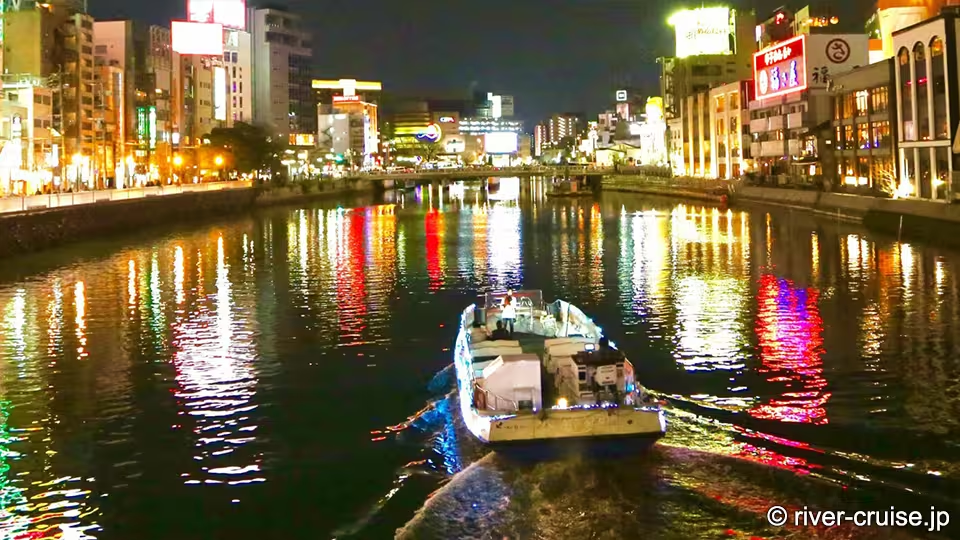
You approach via one of the bridges over the Naka or Hakata rivers—at night, the neon signboards of Nakasu are visible from either bank, their reflections stretching across the water. The island itself feels denser than it looks on a map. The main street is wide enough for pedestrian flow but narrow enough that the building facades on both sides create a kind of visual tunnel of competing signboards: kyabakura names in cursive katakana, photographs of hostesses in ballgowns, prices in large font, floor numbers, arrows pointing upward to clubs on the second through sixth floors of the same building.
The ground level has restaurants and ramen shops; the nightlife climbs the buildings. A single building in Nakasu might have an izakaya on the first floor, a girls bar on the second, a kyabakura on the third and fourth, and a karaoke room on the fifth. This vertical stacking is different from Tokyo's Kabukicho, where clubs tend to occupy entire buildings. In Nakasu, you're constantly aware of the layering—voices and music descending from floors above, hostesses in evening wear waiting at the base of stairs, floor managers standing in doorways greeting passersby.
On the river-facing perimeter, particularly on the Naka River side, the density drops and the atmosphere opens up. This is where the yatai appear: small, semicircular wooden stalls on wheels, each seating perhaps six to ten people on stools around a counter. They're not tourist traps—they're a genuine Fukuoka institution, operating since the postwar era, serving tonkotsu ramen, grilled chicken, oden, and cold Asahi beer to everyone from salarymen to hostesses coming off shift. Eating here, in earshot of the river, with the glow of Nakasu behind you, is as authentically Fukuoka an experience as exists.
Getting to Each District
| District | From Hakata Station | From Tenjin |
|---|---|---|
| Nakasu | Taxi ~8 min / ¥800–¥1,000. Walk ~20 min via Hakata River. Subway: Nakasukawabata Station (Kūkō Line, 2 stops). | Walk ~10 min east across the Naka River. Taxi ~5 min. |
| Tenjin | Subway: Tenjin Station (Kūkō Line, 3 stops, ~6 min). Taxi ~10 min / ¥1,000–¥1,200. | — |
| Hakata Station area | Walk ~5–10 min from the station's east exit (Chikushi exit side). | Subway ~6 min. Taxi ~10 min. |
| Nishijin | Subway: Nishijin Station (Kūkō Line, ~15 min from Hakata). Taxi from Tenjin ~10 min / ¥1,000–¥1,200. | Subway: Nishijin Station (~8 min from Tenjin). Walk ~20 min. |
Frequently Asked Questions
Where are the best hostess clubs in Fukuoka for first-timers?
Nakasu is the city's main entertainment island and the usual first stop, with venues used to out-of-town visitors. Tenjin, the downtown district ten minutes away, has as many hostess clubs at the same or slightly lower budgets. The Hakata Station area is convenient for business travelers, and Nishijin is a local neighborhood option.
Can foreigners visit hostess clubs in Fukuoka?
Yes. Fukuoka is more internationally accustomed than most Japanese cities. The main practical barrier is language—most hostesses speak Japanese only, so a translation app is strongly recommended. Book in advance, dress appropriately, and confirm pricing before sitting. These three steps make the experience accessible regardless of language ability.
How much should I budget for a Fukuoka hostess club?
Most hostess clubs in Nakasu list a budget of ¥8,000–¥11,000, and most in Tenjin and Nishijin ¥5,000–¥11,000. These are budget guides published by venues on NightStyle: one set plus a minimal hostess drink, tax and service included. Designation, extensions, and extra drinks cost more.
What is Hakata Bijin and why does it matter?
Hakata Bijin (博多美人) is the cultural identity attached to women from the Fukuoka/Hakata area—a centuries-old reputation for beauty combined with a warm, outgoing, and direct personality. It's not marketing language; it's a real identity that many Fukuoka women take seriously. In hostess clubs, it manifests as a less formal, more naturally playful approach to hospitality than you encounter in Tokyo's polished top-tier venues. The local Hakata-ben dialect reinforces this—its softened consonants and distinctive intonation give conversation a warmer, less professional register.
What's the difference between Nakasu and Tenjin?
Nakasu is Fukuoka's traditional entertainment island: dense, lively, and the usual starting point for visitors. Tenjin is the main downtown shopping and business district, ten minutes away on foot, with a similar number of hostess clubs at the same or slightly lower budgets. Choose by where you are staying.
How does Fukuoka nightlife compare to Tokyo?
Cheaper than Kabukicho and more approachable. Most Nakasu venues list a budget of ¥8,000–¥11,000, against ¥11,000–¥20,000 in Kabukicho. Nakasu at peak hours is lively without the overwhelming scale of Kabukicho, and the hostess culture in Fukuoka (Hakata Bijin) leans warmer and less formal. For first-time visitors, Fukuoka is a good starting point.
Can I eat at the yatai before going to a club?
Yes—and you should. Fukuoka's yatai stalls on the Naka River banks are a genuine institution and one of the best cheap dining experiences in Japan. They operate from roughly May through October; in winter, tonkotsu ramen shops fill the same role. Arrive in Nakasu around 7–8pm, eat at a yatai, then walk into a club around 9pm. That sequence—dinner, then nightlife—is the ideal first-timer structure for a Fukuoka evening.
Is it safe to visit Nakasu at night?
Yes. Nakasu is a commercial entertainment district with a heavy police and security presence. Petty crime is rare. The main practical risk for foreign visitors is not safety but overcharging—which is avoided by booking in advance, confirming pricing in writing before sitting, and never following street touts. These precautions apply equally to any nightlife district in Japan.
Fukuoka:
Worth More Than a Layover
Most Japan itineraries treat Fukuoka as a transit point—a night or two between Hiroshima and a flight home, or the starting point for a Kyushu loop. That's a reasonable structure. But the city rewards an extra day, and its nightlife rewards an extra evening.
Nakasu is easy to navigate, well-priced, and genuinely alive in a way that compact entertainment districts often aren't. The Hakata Bijin reputation isn't myth—the warmth and directness of Fukuoka hostesses is a real and consistent feature of the scene here. And the combination of riverside yatai, dense club streets, and a compact, walkable geography makes for an evening that holds together as a whole experience rather than a single venue.
If you've been to Tokyo's Kabukicho, Fukuoka will feel familiar but quieter and more personal. If this is your introduction to Japanese nightlife, it's a better starting point than the more overwhelming Tokyo alternatives.
For the full background on how hostess clubs work in Japan—pricing structures, the shimei system, rules, what to wear, and how to avoid scams—read our complete Japan hostess club guide, or start from the basics with What Is Kyabakura?. For the wider Nakasu district—food, sights, daytime—see our Nakasu guide. And for how Fukuoka compares to Japan's other hostess cities, see Kabukicho, Ginza, Osaka, Sapporo's Susukino, and Nagoya.