Osaka Hostess
Club Guide
Kita and Minami:
Two Cities in One Night
Osaka is Japan's second city and, by most measures, its most fun one. It's the country's comedy capital, its street-food capital, and the place where the Japanese reputation for reserve goes to die. Osaka's hostess club scene inherits all of that—and it's split, like everything else in Osaka, between two rival halves.
Kita (北, "north") is the Umeda station area and, just south of it, Kitashinchi—Osaka's Ginza, a tight grid of formal, expensive, introduction-based clubs where the Kansai business elite entertain. Minami (南, "south") is Namba, Shinsaibashi, and the Dotonbori canal—and along the canal's north bank, Soemoncho, the loudest and densest hostess club street west of Tokyo. Kita is quiet money. Minami is noise, neon, and takoyaki smoke. Osakans will argue about which is the real Osaka; the honest answer is that you should see both.
This guide covers both zones, how they differ from Tokyo, what they cost, and why—if you've only experienced hostess clubs in Tokyo—Osaka may change your mind about what the whole thing is for.
Why Osaka Hostesses Are Different: Comedy as Hospitality
In Tokyo, a hostess's job is to make you feel important. In Osaka, her job is to make you laugh—and if she can make you laugh at yourself, she's doing it well.
This isn't a stereotype; it's the city's operating system. Osaka is the home of manzai, Japan's dominant form of stand-up comedy—a two-person act built on the boke (the fool who says something absurd) and the tsukkomi (the straight man who slaps it down). Every Osakan grows up fluent in this rhythm. Conversation in Osaka is expected to have timing, to have a punchline, to involve a certain amount of mutual teasing. Being too polite is read as cold. Being too serious is read as boring.
Osaka's hostesses carry this straight into the club. Where a Tokyo kyabakura hostess will agree with you, flatter you, and keep things smooth, an Osaka hostess is far more likely to tease you, contradict you for effect, and treat the conversation as a two-way game. If you say something ridiculous, she'll call it out—"nande ya nen!" (何でやねん, roughly "what are you even saying?")—and the table will laugh. The Osaka dialect, Kansai-ben, is itself a comedic instrument: faster, bouncier, and warmer than standard Tokyo Japanese, with endings and intonations that make even a scolding sound affectionate.
The Districts: Where to Go and What You'll Find
01.Soemoncho (宗右衛門町)
The hostess club heart of Minami and the natural first stop. Soemoncho is a single street running east–west along the north bank of the Dotonbori canal, one block from the tourist chaos of Dotonbori itself. It began life as a geisha district in the Edo period and transitioned to cabarets, then kyabakura, through the twentieth century. Today it's a corridor of multi-floor buildings stacked with clubs—signboards with hostess photographs, prices in large type, floor managers in doorways, and a steady flow of customers from the neighboring izakayas.
The Minami venues listed on NightStyle all give budgets of ¥11,000 or less. The atmosphere is Minami—loud, warm, unpretentious. Walk-ins are normal. English signage exists at some venues because of the tourist traffic one block away. If you have one night in Osaka, this is where it goes.
02.Kitashinchi (北新地)
Osaka's Ginza. A compact grid immediately south of Osaka/Umeda Station, bounded roughly by Shin-Midosuji and the Dojima river. Kitashinchi has operated as a high-end entertainment district since the 1700s and holds exactly the position in Kansai that Ginza holds in Kanto: small, formal clubs run by mama-sans, introduction-based entry at the top tier, hostesses chosen for conversational skill and poise, and bills that routinely exceed ¥50,000. The Kansai business world—Osaka's trading houses, manufacturers, and pharmaceutical giants—entertains here.
Kitashinchi is slightly less impenetrable than Ginza. Its clubs are, on balance, a touch more open to new faces, its prices run 10–20% lower, and its mama-sans are—this being Osaka—more likely to crack a joke. It also has kyabakura that take reservations from first-time visitors; most of those listed on NightStyle for the Kita area give budgets of ¥14,000–¥17,000. Dress code applies: jacket minimum. Closes early, like Ginza—midnight to 1 AM.
03.Umeda (梅田)
The streets around Osaka and Umeda stations—particularly east of the station toward Higashi-Umeda and Ohatsu Tenjin—hold a scatter of mid-range kyabakura catering to the enormous commuter and business-traveler population of Japan's second-busiest rail hub. Less atmospheric than Soemoncho, less prestigious than Kitashinchi, but convenient if you're staying in a Umeda hotel and don't want to cross the city. Listed budgets across Kita range from ¥5,000 to ¥20,000, most at ¥14,000–¥17,000. Venues here see a high volume of unfamiliar faces and are correspondingly relaxed about first-timers.
04.Namba & Shinsaibashi (難波・心斎橋)
Soemoncho is the concentrated strip, but hostess venues spread through the surrounding Minami blocks—south toward Namba station, north along the Shinsaibashi-suji arcade's back streets, and into the Higashi-Shinsaibashi area. This wider zone also has Osaka's girls bars, lounges, and the host clubs (the male-hostess mirror image, for a female clientele) that line parts of Higashi-Shinsaibashi. For a visitor, treat Soemoncho as the destination and these blocks as the neighborhood you're walking through to get there—and as the place for a second drink afterward.
Kita vs Minami: Choosing Your Osaka
| Feature | Kita (Kitashinchi / Umeda) | Minami (Soemoncho / Namba) |
|---|---|---|
| Atmosphere | Formal, quiet, business | Loud, warm, street-level |
| Dominant format | Club (クラブ) + lounges | Kyabakura |
| First visit (typical) | ¥14,000–¥17,000 at most listed kyabakura; clubs far more | Up to ¥11,000 at listed venues |
| Walk-in friendly | Lower tier only | Yes |
| Dress code | Jacket minimum | Smart casual |
| Closing | Midnight–1 AM | Hostess clubs to 1 AM; bars later |
| Foreigner familiarity | Moderate | High (next to Dotonbori) |
| Best for | Seeing Kansai's elite tier | A genuinely fun first night |
Our honest recommendation for a first visit: Minami. Soemoncho delivers the Osaka personality at full strength, it's accessible without a reservation, and it's a five-minute walk from the best street food in Japan. Come back to Kitashinchi on a second night, with a reservation and a jacket, once you've calibrated.
Browse Osaka Venues on NightStyle
See real venues with photos, set prices, opening hours, and customer reviews. These are the listings Japanese customers use to choose where to go.
Listings are in Japanese. Your browser's built-in translation (Chrome, Safari, Edge) handles them well.
An Osaka Evening: Dotonbori to Soemoncho
Minami is one of the few places in Japan where dinner, drinks, and hostess clubs sit within a three-minute walk of each other. The ideal sequence takes advantage of that.
8:00 PM
Eat in Dotonbori or Hozenji Yokocho
Osaka is a kuidaore city—"eat until you drop." Takoyaki and kushikatsu from Dotonbori's stalls, or a quieter sit-down at one of the tiny restaurants in Hozenji Yokocho, the lantern-lit alley just south of the canal. Eat properly: clubs serve snacks at best, and an Osaka night runs long.
9:30 PM
Cross the canal to Soemoncho
From Dotonbori's south bank, cross any bridge north and you're on Soemoncho. Clubs open around 7–8 PM and are comfortable by 9. Arriving in this window means easy walk-in seating, unhurried hostesses, and a quieter room—better for conversation across a language gap.
Midnight
Peak Soemoncho
Full volume. Salarymen groups arriving from izakayas, the street busy, every building's elevator in use. This is when Minami's energy is at its most Osaka—and when the teasing, fast-talking hostess style is in full swing. If you want the atmosphere rather than a quiet chat, be inside a club by 10.
midnight
Minami keeps going
Unlike Kitashinchi, Minami doesn't close at the last train. Soemoncho's hostess clubs close by 1 AM under licensing rules, but the surrounding blocks have standing bars, late ramen, and girls bars until dawn. A hostess who enjoyed your table may suggest an afutā at a bar she knows nearby—more common in Osaka than Tokyo, and entirely at her discretion.
What Osaka Costs
Minami is one of the cheapest major hostess districts in Japan; Kita is priced close to Kabukicho. The figures below are the budgets venues themselves publish.
| District | Budget guide at most listed venues | Venues counted |
|---|---|---|
| Osaka: Minami | Up to ¥11,000 | 7 |
| Osaka: Kita (Umeda, Kitashinchi) | ¥14,000–¥17,000 | 9 |
| Tokyo: Kabukicho | ¥11,000–¥20,000 | 18 |
| Tokyo: all districts | ¥5,000–¥11,000 | 135 |
The one rule: confirm the set fee, time, inclusions, service charge, and extras before you sit—every time, at every venue. Osaka venues are generally straightforward about pricing (Osakans have no patience for vagueness about money), but Soemoncho has touts, and touted venues are the exception. Never follow a tout. Enter only venues you've researched or booked.
How a Visit Works
Enter and confirm the price
A floor manager greets you and seats you. Before anything else, ask for the pricing sheet and confirm set fee, time, what's included, and the service charge. In Minami this takes thirty seconds and nobody minds.
Your hostess sits—and probably opens with a joke
Osaka hostesses tend to lead with energy. Expect a quick question about where you're from, followed by a reaction to the answer. Match it. If you can deliver a line back, even a clumsy one, you've made a friend for the evening.
Translation apps are an asset here
In Osaka specifically, a mistranslation is a gift—it becomes material. Use your app openly. An Osaka hostess will read it, laugh at the awkward output, correct it, and the exchange becomes the conversation. The language barrier is less of a wall here than anywhere else in Japan.
Rotation, extension, bill
Most Soemoncho kyabakura rotate hostesses every 20–30 minutes. Near the end of your set, you'll be offered an extension; declining is normal. Ask for an itemized bill, check it against what you confirmed, and pay at the table. LINE exchange with a hostess you liked is common and carries no obligation.
New to hostess clubs entirely? Start with our complete Japan hostess club guide for the fundamentals, then come back here.
Soemoncho at Street Level
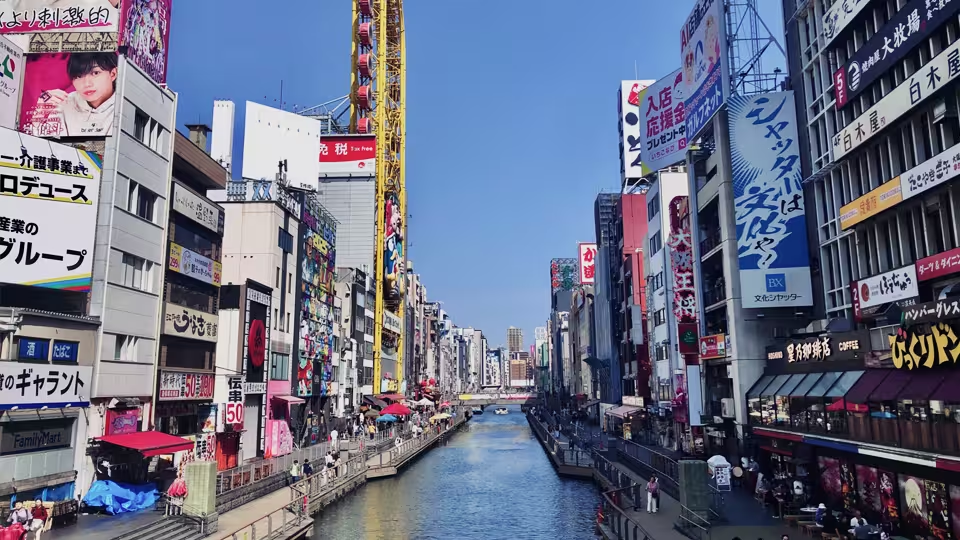
Stand on Ebisu-bashi—the bridge with the Glico running man sign—facing north, and the river of tourists is behind you. One block ahead, parallel to the canal, is Soemoncho. The transition is abrupt: the Dotonbori crowd is families and tour groups photographing crab signs; Soemoncho's foot traffic is men in suits, groups of salarymen fresh from a nomikai, and hostesses in dresses walking quickly to their shifts with convenience store bags.
The street is narrower than it looks on a map and the buildings are taller than you expect—six, seven, eight floors of clubs, each with a backlit sign at street level and a directory at the elevator. The signage is Osaka: bigger, brighter, and less restrained than Kabukicho's, with hostess portraits at poster scale and prices in characters large enough to read from across the street. Floor managers in black suits stand in the doorways and greet passersby with a nod rather than a pitch—the touts, when present, are a different breed and easy to distinguish: they approach, they walk alongside, they offer deals. Ignore them.
The historical layer is still visible if you look for it. Soemoncho's name is Edo-period; the alley to the south, Hozenji Yokocho, keeps the old stone paving and the moss-covered Fudō statue that worshippers splash with water. The canal itself—the thing the whole district was built around—is a step away. Osaka's nightlife has always been here, in this exact spot, for four hundred years. The kyabakura are just the current tenants.
Getting There
| District | Station | Notes |
|---|---|---|
| Soemoncho | Namba (Midosuji, Yotsubashi, Sennichimae lines; Nankai; Kintetsu) exit 14; Nippombashi (Sakaisuji, Sennichimae) exit 2 | Cross Dotonbori canal northward from Ebisu-bashi or Tazaemon-bashi. 3–5 min walk. |
| Kitashinchi | Kitashinchi (JR Tozai Line); Osaka / Umeda (JR, Hankyu, Hanshin, Midosuji) south exits | Immediately south of the station complex across Shin-Midosuji. 5–8 min walk from Osaka Station. |
| Umeda | Osaka / Umeda / Higashi-Umeda | Kyabakura cluster toward Ohatsu Tenjin shrine, east side. |
| Kita ↔ Minami | Midosuji Line, Umeda → Namba | 8 minutes, 4 stops. Last train ~midnight. Taxi ¥2,000–¥2,500. |
Frequently Asked Questions
Where are the hostess clubs in Osaka?
Two zones. Kita (north): Kitashinchi for formal high-end clubs and Umeda for mid-range kyabakura. Minami (south): Soemoncho—the dense strip along the Dotonbori canal—plus the surrounding Namba and Shinsaibashi blocks. Minami is louder and more accessible; Kita is quieter and more expensive.
What is Kitashinchi?
Kitashinchi is Osaka's most prestigious nightlife district, just south of Osaka/Umeda Station, and holds the position in Osaka that Ginza holds in Tokyo: small, formal, mama-san-run clubs serving the Kansai business elite, with top-tier entry by introduction. The area also has kyabakura that accept first-time reservations; most of those listed on NightStyle for Kita give budgets of ¥14,000–¥17,000. Jacket required at the clubs.
What is Soemoncho?
The hostess club street of Minami: a single east–west street along the north bank of the Dotonbori canal, one block from the tourist strip. A former geisha quarter, now Osaka's densest kyabakura corridor—walk-in friendly, energetic, open late. The natural first stop.
How much do Osaka hostess clubs cost?
Minami (Soemoncho, Namba) venues listed on NightStyle all give budgets of ¥11,000 or less. Most kyabakura in Kita (Umeda, Kitashinchi) give ¥14,000–¥17,000. A budget guide covers one set plus a minimal hostess drink, tax and service included; designation, extensions, and extra drinks cost more. Kitashinchi's formal clubs cost far more.
How are Osaka hostesses different from Tokyo?
Funnier, faster, and more direct. Osaka is Japan's comedy capital and its conversational culture is built on timing and teasing. Hostesses here are more likely to joke with you and push back than to simply flatter. Kansai-ben, the local dialect, adds warmth. Many visitors who found Tokyo clubs too polished prefer Osaka.
Can foreigners go to hostess clubs in Osaka?
Yes. Minami is highly foreigner-accustomed because of its proximity to Dotonbori. Walk-ins are fine at most Soemoncho kyabakura; booking ahead is better. Kitashinchi's top clubs are introduction-based, but its lounges take reservations. Use a translation app, dress smart casual (jacket for Kitashinchi), and confirm pricing before sitting.
Is Osaka cheaper than Tokyo for hostess clubs?
In Minami, yes: listed venues give budgets of ¥11,000 or less, against ¥11,000–¥20,000 at most Kabukicho venues. Kita is priced close to Kabukicho at ¥14,000–¥17,000. The bigger difference between the cities is atmosphere.
Should I do Kita or Minami first?
Minami. Soemoncho gives you the full Osaka personality, needs no reservation, and sits beside the best street food in Japan. Save Kitashinchi for a second night with a reservation and a jacket.
Osaka:
The Night That Talks Back
If Tokyo's hostess clubs are about being made to feel important, Osaka's are about being made to feel included—pulled into the joke, teased, argued with, fed, and sent home laughing. It's the same industry, run by a city with a fundamentally different idea of what a good time is.
Start in Minami. Eat in Dotonbori, cross the canal to Soemoncho, walk into a club you've researched, and let the hostess set the pace. Come back for Kitashinchi when you want to see the Kansai elite's quieter version. Either way, you'll leave with a different understanding of Japanese nightlife than Tokyo alone could give you.
For the wider city—food, neighborhoods, what to do before dark—see our Osaka guide and Osaka nightlife guide. For how hostess clubs work in general, read the Japan hostess club guide or What Is Kyabakura?. For the Tokyo comparison, see Kabukicho and Ginza; for Japan's other regional nightlife cities, see Fukuoka, Sapporo, and Nagoya.