Susukino Hostess
Club Guide
The Biggest Night
North of Tokyo
Sapporo is a city of two million people that behaves, after dark, like a city of ten. Susukino—its entertainment district—is the largest nightlife area in Japan outside Tokyo and Osaka, a ten-by-ten-block grid holding several thousand bars, restaurants, hostess clubs, snack bars, and lounges. It is one of the "three great nightlife districts" of Japan alongside Kabukicho and Fukuoka's Nakasu, and of the three it's the one that feels most like a frontier town: wide streets, square blocks, buildings lit from top to bottom, and in winter, snow piled at every corner.
Susukino's hostess club scene has the scale of a major city with the prices of a regional one. It even has its own vocabulary: hostess clubs here are nyūkura, "new clubs," and the word kyabakura means something different (explained below). It has a character shaped by Hokkaido—Japan's northern island, settled late, with a reputation for straightforward, easygoing people and none of the mainland's layered formality. And it has a seasonality unlike anywhere else in Japan: a district that runs at full energy through -10°C nights, that fills with ski tourists from December to March, and that has invented its own late-night ritual (the shime-parfait) because ending a night with ramen apparently wasn't enough.
This guide covers how Susukino is laid out, what its hostess clubs cost and feel like, how the winter changes things, and how to visit as a foreigner.
Dosanko Hospitality: Why Hokkaido Feels Different
Hokkaido was not fully settled by Japanese until the late 1800s. Sapporo itself was laid out in 1869 on an American-style grid by planners who had studied Western cities—which is why it looks like no other Japanese city, and why its people have, for 150 years, thought of themselves as somewhat apart from the mainland.
Hokkaido natives are called dosanko (道産子), a word originally for the island's hardy native horses and now a point of regional pride. The dosanko stereotype—which, like most regional stereotypes in Japan, has real texture to it—is of people who are direct, relaxed, unbothered by hierarchy, and generous in a plainspoken way. The settler history matters here: Hokkaido was built by people who left the old provinces, the old family lines, and the old rules behind. Formality was a luxury the frontier couldn't afford.
Susukino's hostess culture carries this. It is less performative than Tokyo's and less comedic than Osaka's—closer to a genuinely easygoing bar conversation with someone who happens to be very good at it. Hostesses here are, on average, less concerned with the elaborate ritual of the role (the precise angle of the pour, the choreographed deference) and more concerned with whether you're actually having a good time. For visitors who find the hostess concept artificial, Susukino is often where it clicks: the artifice is thinner, and what's underneath is warmer.
"New Club" vs "Kyabakura": The Word That Changes Meaning in Hokkaido
Before you walk into Susukino looking for a kyabakura, one thing you need to know: in Hokkaido, that word does not mean what it means in the rest of Japan.
The hostess club described on this page, with a hostess who sits at your table, pours drinks, and talks, is called a ニュークラブ (nyū kurabu, "new club") in Sapporo, usually shortened to ニュークラ (nyūkura). That is the word on the signs, on the building directories, and in local listings.
The word キャバクラ (kyabakura) is also used in Susukino, but for a different business. Here it refers to an adult-oriented type of venue that involves physical contact with staff, the kind that other regions call by other names. A visitor who knows the Tokyo meaning and walks into a Susukino venue marked キャバクラ expecting conversation and drinks will find something else, at a different price, under different rules.
| Word on the sign | In Tokyo, Osaka, Fukuoka, Nagoya | In Sapporo / Hokkaido |
|---|---|---|
| ニュークラブ / ニュークラ nyū kurabu / nyūkura | Rarely used | Hostess club: conversation and drinks at your table. This is what this guide covers. |
| キャバクラ kyabakura | Hostess club: conversation and drinks at your table | A different, adult-oriented venue type involving physical contact. Not a hostess club. |
| クラブ kurabu | Formal, mama-san-run, high-end hostess venue | Same meaning |
Reading the Grid: How Susukino Is Organized
Sapporo's address system is the simplest in Japan once you understand it, and in Susukino it's essential. The city is divided by two axes—Odori Park running east–west, and Sosei River running north–south—and every block is named by its distance from them. Minami 5, Nishi 4 (南5西4) means five blocks south of Odori, four blocks west of Sosei. That's it. Every club address in Susukino is a pair of numbers like this, and once you've found one, you can find any other.
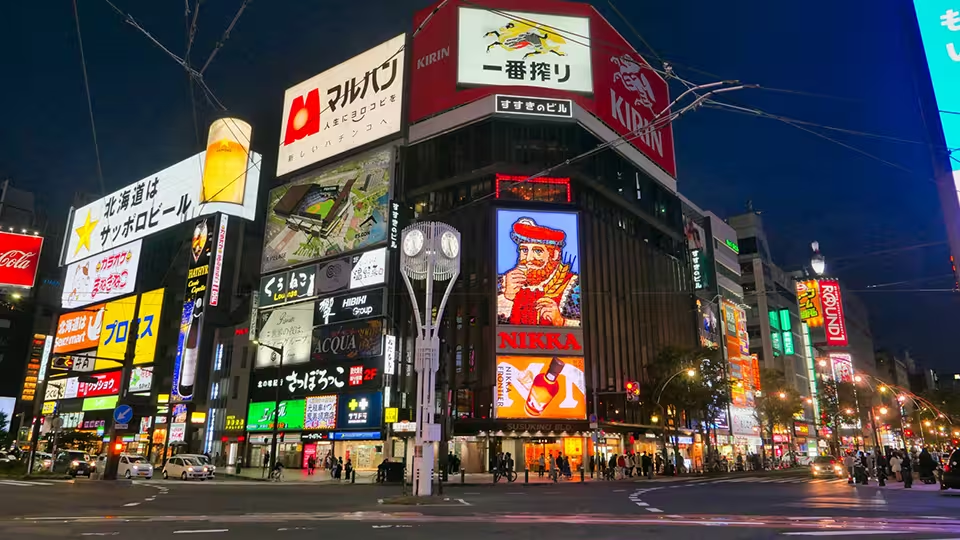
Susukino's core runs roughly from Minami 4 to Minami 7 and Nishi 2 to Nishi 6. The center is the Susukino intersection at Minami 4, Nishi 4—the crossroads under the famous illuminated Nikka Whisky sign, the single most recognized image of Sapporo nightlife. From there:
| Zone | Blocks | Character |
|---|---|---|
| Central Susukino | Minami 4–5, Nishi 3–5 | The densest concentration of new clubs, girls bars, and mid-to-upper clubs. Multi-floor buildings with 6–10 venues each. Where most visitors should start. |
| South Susukino | Minami 6–7, Nishi 3–5 | Quieter, more local. Snack bars, smaller lounges, longer-established clubs with regular clienteles. Also the location of Ramen Yokocho. |
| West Susukino | Minami 4–6, Nishi 5–6 | Mixed: hostess venues alongside restaurants and hotels. Some of Susukino's higher-end clubs are tucked in here, deliberately away from the main crossing. |
| Tanuki-koji edge | Minami 2–3 | North of Susukino proper. The covered shopping arcade and its surroundings have izakayas and casual bars—good for dinner before heading south. |
Everything in Susukino is within a ten-minute walk of everything else. In winter, the Pole Town underground shopping street connects Odori to Susukino station without going outside—useful for the approach, though you'll surface into the cold for the final blocks.
What Susukino Offers: Venue Tiers
01.New Club / Nyūkura (ニュークラブ) — the hostess club
Susukino's dominant format and the bulk of what you'll see in the central blocks—signposted locally as ニュークラブ (see above for why the word kyabakura means something else here). Mid-size venues with a roster of hostesses, printed pricing, rotation, and listed budgets of ¥5,000–¥14,000, most at ¥8,000–¥11,000. Walk-in friendly, used to tourists, and often with staff who can manage basic English because of the district's international ski traffic. The right starting point.
02.Snack bars (スナック)
Susukino has an unusually high density of snack bars—tiny counter-seat venues run by a mama-san, with a handful of regulars, karaoke, and a bottle-keep shelf. Not hostess clubs in the structured sense, but the same hospitality tradition at its most intimate and local. Susukino's snack culture is strong because of Hokkaido's long winters and small-town roots; many of these venues have been running for decades. Harder for a foreign visitor to enter cold (the regulars are the venue), but extraordinary if you're introduced.
03.Clubs & lounges (クラブ・ラウンジ)
Susukino also has venues that call themselves clubs and lounges: smaller, calmer rooms, mostly in West Susukino and the quieter blocks. The handful listed on NightStyle give budgets up to ¥11,000, no higher than the new clubs. Reservations from new customers are generally accepted.
04.Girls bars (ガールズバー)
Counter-seat venues where female staff serve drinks across the bar—no table service, no set fee in most cases, and budgets under ¥5,000 at every listed venue. Susukino has many, particularly around the central crossing. A low-commitment way to experience the hospitality concept, and the format most likely to have English-speaking staff. See our girls bar guide for how they work.
Browse Susukino Venues on NightStyle
See real venues with photos, set prices, opening hours, and customer reviews. These are the listings Japanese customers use to choose where to go.
Listings are in Japanese. Your browser's built-in translation (Chrome, Safari, Edge) handles them well.
Susukino by Season
No other hostess district in Japan is shaped by weather the way Susukino is. The year has three distinct registers.
Mar
Deep winter: snow, skiers, and the Snow Festival
Temperatures of -5°C to -10°C, snowbanks at every corner, and the district at its most atmospheric. December through March is also peak international season—Niseko and Rusutsu skiers route through Sapporo and many spend a night in Susukino. The first week of February brings the Sapporo Snow Festival and the single busiest week of the year: hotels full, clubs full, reservations essential. Dress for the walk between venues; the taxi queue at the Susukino crossing after midnight is a Sapporo institution.
Jun
Thaw and spring: the local season
Tourist numbers drop, snow melts (slowly—Sapporo's spring is late), and Susukino becomes a local district again. Late May brings the Yosakoi Soran Festival, a massive dance festival that fills Odori and spills south. Clubs are easier to walk into; prices and crowds are at their most relaxed.
Sep
Summer: beer gardens and long evenings
Sapporo's summer is mild and dry—the reason mainland Japanese flee here in August. Odori Park becomes the Sapporo Summer Festival beer garden, the largest in Japan, from late July through mid-August. The natural evening: beer garden at Odori until 9, then walk south into Susukino. Domestic tourism peaks; international visitors are fewer than in winter.
Nov
Autumn: the quiet before the snow
Short, sharp, and beautiful—Hokkaido's foliage peaks in October and the first snow usually falls in early November. Susukino's quietest period and, for many locals, its best: no tourist crowds, cool enough for the clubs to feel welcoming, and easy to get a table anywhere.
Shime-Parfait: Sapporo's Late-Night Ritual
Everywhere else in Japan, a night of drinking ends with ramen—the shime (締め, "closing") bowl. Sapporo invented something stranger and better. Here, the night ends with a parfait.
Shime-parfait (シメパフェ) is exactly what it sounds like: an elaborate, towering dessert—layers of Hokkaido soft-serve, fruit, mousse, crumble, sometimes a shot of liqueur—eaten at 1 or 2 AM in a dedicated late-night parfait café. Susukino has dozens of these, open until 2–4 AM, lit like jewelry boxes among the bars. The custom emerged in the 2010s, driven partly by Hokkaido's dairy industry (the soft-serve really is better here) and partly by Sapporo's hostess and host club workers, who wanted something after their shifts that wasn't another drink. It spread to the general public and is now one of the most distinctive things about a Sapporo night out.
For a visitor, it's the perfect coda to a Susukino evening: walk out of a new club at midnight into the snow, find a parfait café (they cluster around Minami 4–5, Nishi 3–5), and sit among hostesses, salarymen, and students all eating absurd desserts in near-silence. Nothing else in Japanese nightlife is quite like it.
What Susukino Costs
| District | Budget guide at most listed venues | Venues counted |
|---|---|---|
| Sapporo: Susukino (new clubs) | ¥5,000–¥14,000, most at ¥8,000–¥11,000 | 19 |
| Sapporo: Susukino girls bars | Under ¥5,000 | 9 |
| Fukuoka: Nakasu | ¥8,000–¥11,000 | 9 |
| Tokyo: Kabukicho | ¥11,000–¥20,000 | 18 |
Susukino and Nakasu are Japan's two best-value major hostess districts, and they're nearly interchangeable on price. The Snow Festival week is the one period when some Susukino venues raise set fees or add minimums; confirm before sitting, as always.
How a Visit Works
Come in from the cold, confirm the price
In winter you'll be handed a hot oshibori towel the moment you sit—Susukino's small, excellent ritual. Before anything else, ask for the pricing sheet and confirm the structure. Then take your coat off; the clubs run warm.
Your hostess joins—expect an easy start
Susukino hostesses tend to open plainly: where are you from, are you here to ski, how are you handling the cold. The dosanko register is unhurried. There's less of the Tokyo flourish and less of the Osaka banter—just a conversation that starts and keeps going.
Use your translation app; ask about Hokkaido
Most hostesses speak Japanese only. Open your app and use it freely. A reliable conversational door in Susukino is Hokkaido itself—food, snow, where she's from on the island. Dosanko are proud of their region and will talk about it at length.
Extension, bill, and the parfait
Decline or accept the extension; ask for an itemized bill; pay at the table. Then—if it's after midnight—walk to a parfait café. If a hostess you connected with mentions one she likes, that's not an invitation to join her, but it is a good recommendation.
For the fundamentals of hostess clubs anywhere in Japan, see our complete Japan hostess club guide.
Winter Practicalities for Visitors
01.Dress for the street, not just the club
Smart casual works inside; outside is -8°C. Wear a proper coat over your club-appropriate clothes and shoes with grip—Susukino's sidewalks are packed ice from December to March, and the district's regulars walk with a distinctive short, flat-footed shuffle for a reason. Clubs have coat check. Leave the parka there and emerge in your collared shirt.
02.Book ahead in ski season
From late December through February, Susukino absorbs a large share of Hokkaido's international ski traffic on their Sapporo nights. Venues fill. Snow Festival week is the extreme case—walk-in capacity effectively disappears. Reserve through a legitimate platform; it also lets you flag language needs.
03.Plan the taxi, not the train
The Namboku subway line's Susukino station closes around midnight. After that, it's taxis—and the taxi queue at the Susukino crossing on a winter weekend can be twenty minutes long. Hotels within walking distance of Minami 4–6 are worth the premium in winter for exactly this reason.
04.The rules are the same as everywhere
No physical contact. Confirm pricing before sitting. Avoid touts. Smart casual minimum, jacket for the upper tier. Susukino's easygoing register doesn't change the legal and social framework that governs every hostess venue in Japan.
Susukino at Street Level, Midwinter
Come up out of Susukino station at 8 PM on a January evening and the first thing is the cold—dry, sharp, immediate. The second thing is the light. Sapporo's grid means every street is a straight line to the horizon, and in Susukino every one of those lines is walled on both sides with illuminated buildings, eight and ten stories of signboards stacked vertically, their color thrown back off the snow on the road. The Nikka sign presides over the crossing, the whisky man in his top hat glowing against a black sky.
The streets are wide—wider than any Tokyo nightlife district—and the snow is pushed into berms along the curbs, hard-packed and gray at the base, white on top. People walk down the middle of the sidewalks in heavy coats, breath visible, moving fast between doorways. Hostesses in long down coats over evening dresses, bare legs in the cold, hurry to shifts. Groups of salarymen debate which building. Ski tourists in technical jackets photograph the sign. Taxis idle in a long line at the crossing, exhaust rising.
Step into a building, take the elevator to the fourth floor, open a door, and the temperature difference is thirty degrees. The room is low-lit and warm, a hot towel appears in your hands, and someone is already pouring. Outside, through a window if the club has one, the snow keeps falling on the brightest ten blocks in northern Japan. This is what Susukino is for.
Getting There
| From | Route | Time / cost |
|---|---|---|
| Sapporo Station | Namboku Line (subway) → Susukino, 2 stops. Or walk south via Pole Town underground from Odori. | 4 min / ¥210. Walk ~20 min. |
| Odori | Walk south 4 blocks, or Pole Town underground to Susukino station. | 7–10 min on foot. |
| New Chitose Airport | JR Rapid Airport to Sapporo Station, then subway. | ~50 min total / ¥1,300+. |
| Late night, back to hotel | Taxi from the Susukino crossing or Minami 5 ranks. | ¥800–¥1,500 within central Sapporo. Queue in winter. |
Frequently Asked Questions
What is Susukino?
Sapporo's entertainment district—the largest nightlife area in Japan north of Tokyo and one of the country's "three great" districts with Kabukicho and Nakasu. A grid of roughly 10×10 blocks south of Odori Park, centered on the Susukino crossing and its Nikka Whisky sign, holding several thousand bars, new clubs, snack bars, and restaurants.
What is a "new club" (ニュークラブ)?
"New club" (ニュークラブ, nyū kurabu, often shortened to ニュークラ / nyūkura) is the Hokkaido term for what the rest of Japan calls a kyabakura: a hostess club with a hostess roster, set fees, and conversation at your table. In Sapporo the word kyabakura (キャバクラ) means something else, a different, adult-oriented type of venue that involves physical contact. If you want a hostess club in Susukino, look for ニュークラブ.
How much do Susukino hostess clubs cost?
Susukino's new clubs listed on NightStyle give budgets of ¥5,000–¥14,000, most at ¥8,000–¥11,000. That covers one set plus a minimal hostess drink, tax and service included. Girls bars are under ¥5,000. This is about the same as Fukuoka's Nakasu and well below Kabukicho's ¥11,000–¥20,000. Some venues add a premium in Snow Festival week.
Can foreigners visit hostess clubs in Sapporo?
Yes. Susukino sees heavy international traffic from skiers and Snow Festival visitors and is accustomed to non-Japanese guests. Most hostesses speak only Japanese—bring a translation app. Book ahead in winter; walk-ins are fine the rest of the year.
What is shime-parfait?
Sapporo's custom of ending a night out with an elaborate parfait at a late-night dessert café instead of ramen. Dozens of cafés in Susukino stay open until 2–4 AM for it. Popular with hostesses after shifts and now a general local ritual—and one of the most distinctive things about a Sapporo night.
What is Susukino like in winter?
-5°C to -10°C, heavy snow, and fully operational. The compact grid and underground walkways make it navigable; the warm interiors make hostess clubs feel especially welcoming. Early February's Snow Festival is the busiest week of the year—reservations essential. Wear grippy shoes.
How do I navigate the address system?
"Minami 5, Nishi 4" = 5 blocks south of Odori Park, 4 blocks west of Sosei River. Susukino's core is Minami 4–7, Nishi 2–6. The Susukino crossing is Minami 4, Nishi 4. Every address is a pair like this; once you've found one, you can find any.
How is Susukino different from Kabukicho?
Wider streets, a grid you can actually navigate, lower prices, a more relaxed and less performative hostess style, far fewer touts, and a winter that defines the whole experience. Kabukicho is denser and more intense; Susukino is bigger-feeling, calmer, and in January, far more atmospheric.
Susukino:
Warmth at the Edge of the Map
Susukino is the hostess district that makes the most sense to people who don't understand hostess districts. The cold explains it. The frontier plainness of the people explains it. Walking out of the snow into a warm room where someone is glad to see you—there's no cultural translation needed for that.
Go in winter if you can. Book ahead if it's February. Dress for the ice, check your coat, confirm the price, and let the dosanko version of hospitality do its work. Then walk out at 1 AM and eat a parfait in the snow, because you're in Sapporo and that's what Sapporo does.
For the wider district—dining, daytime, the Snow Festival—see our Susukino guide. For how hostess clubs work in general, read the Japan hostess club guide or What Is Kyabakura?. For Japan's other great regional nightlife cities, compare Fukuoka's Nakasu, Osaka, and Nagoya; for Tokyo, see Kabukicho and Ginza.