Nagoya Hostess
Club Guide
The City Everyone
Passes Through
Nagoya has a problem, and it's the Shinkansen. Japan's third-largest metropolitan area sits exactly halfway between Tokyo and Kyoto on the bullet train line, and the overwhelming majority of visitors see it for ninety seconds through a window. Japanese people joke about it. Nagoya's own tourism board has, at various points, run self-deprecating campaigns about being the country's least interesting major city.
This is a mistake, and nowhere more so than after dark. Nagoya is the capital of the Tokai region and the home of Toyota, and it is—quietly, without any interest in advertising the fact—one of the wealthiest cities in Japan. Its nightlife district, Nishiki 3-chome, is a full-scale entertainment quarter on the model of Kabukicho or Osaka's Soemoncho, with venues built to a standard of interior luxury that reflects the local money. And its hostess culture is shaped by one of Japan's most distinctive regional archetypes: the Nagoya-jō, the immaculately groomed, brand-conscious, conservatively glamorous young woman of Nagoya.
This guide covers Nishiki and Nagoya's other nightlife zones, what the Nagoya style actually means in a hostess club, what it costs, and why a visitor who's already done Tokyo and Osaka should get off the train here.
Nagoya-jō: The Archetype Behind the Aesthetic
Every Japanese person knows the phrase Nagoya-jō (名古屋嬢), and knows exactly what it conjures: a young woman with large, voluminous curls—the famous Nagoya-maki (名古屋巻き, "Nagoya roll")—a designer handbag, pearls or a conspicuous brand logo, a conservative but expensive dress, flawless makeup, and an air of polished, affluent composure. The look emerged in the early 2000s, was codified by fashion magazines, and became shorthand for a particular kind of Japanese femininity: glamorous but not edgy, wealthy but not Tokyo-fashionable, traditional in values and lavish in presentation.
The archetype comes directly from Nagoya's economic and social character. The city is rich—the Tokai region's manufacturing base, anchored by Toyota and its hundreds of suppliers, has produced generations of stable, affluent families. It is also socially conservative in a way Tokyo and Osaka aren't: a city of family businesses, of marriages treated as alliances between households, of a famous local saying that a daughter's wedding should bankrupt her father. Nagoya weddings are legendarily extravagant. The Nagoya-jō is the daughter of this world—raised to present well, marry well, and spend conspicuously on the right things.
Nagoya's hostess clubs draw on this archetype deliberately. Where a Tokyo kyabakura hostess might be styled toward youth and sparkle, and an Osaka hostess toward approachable energy, a Nishiki hostess is more likely to be styled toward the Nagoya-jō ideal: the big hair, the elegant dress, the composed and slightly formal manner, the sense of a well-brought-up young woman who has chosen to be here.
Nagoya's Nightlife Districts
01.Nishiki 3-chome — "Kin-san" (錦三丁目)
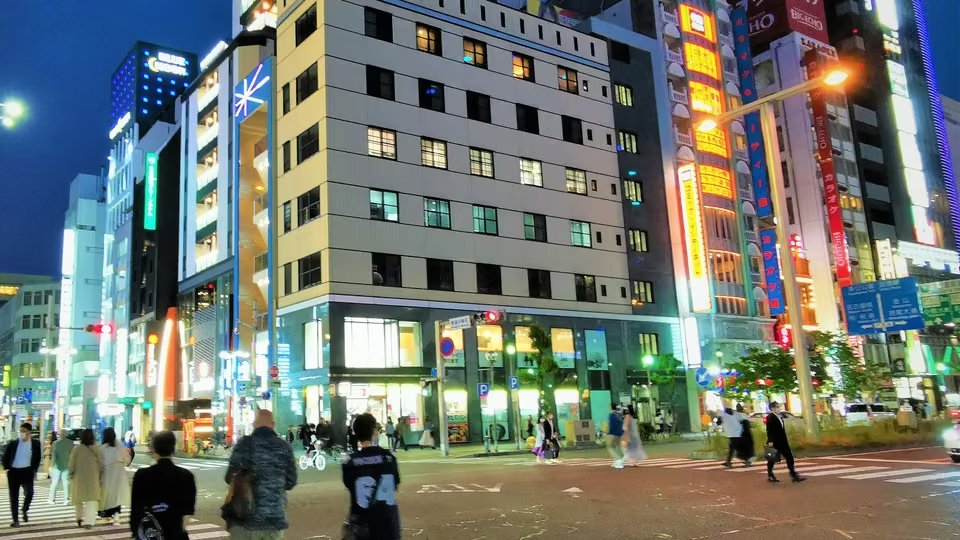
Nagoya's entertainment district and the destination for essentially all of the city's hostess club activity. Nishiki 3-chome—locals say Kin-san (錦三)—is a compact set of blocks immediately west of Hisaya-odori Park and Sakae's department stores, running between Nishiki-dori to the north and Hirokoji-dori to the south, roughly from Hisaya-odori to Fushimi. It's the Tokai region's Kabukicho: multi-floor buildings stacked with kyabakura, clubs, lounges, girls bars, host clubs, and izakayas, signboards from street level to roofline.
What distinguishes Nishiki from Kabukicho or Soemoncho is its texture. It's cleaner and more orderly than Kabukicho, more polished than Soemoncho, and its buildings—many renovated with Tokai money—have a consistency of upscale finish that's unusual for a nightlife district. Touts exist but are fewer and less aggressive than Tokyo's. The customers are Nagoya's business class: automotive executives, suppliers entertaining Toyota, the city's substantial population of family-business owners. The full range, from accessible kyabakura to serious clubs, is within a five-minute walk.
02.Sakae (栄)
Sakae is the commercial heart of Nagoya—department stores, the Oasis 21 complex, the TV tower, Hisaya-odori Park—and Nishiki sits inside its western edge. In nightlife terms, "Sakae" is often used loosely to mean the whole central entertainment area including Nishiki, and a search for Sakae hostess clubs will land you in Kin-san. Sakae proper, east of the park, has bars, restaurants, and some lounges, but the dense hostess concentration is Nishiki. Use Sakae as your orientation point and walk west.
03.Meieki — Nagoya Station Area (名駅)
The streets around Nagoya Station's east side—Meieki 3 and 4-chome, toward Nishiki-dori's western end—hold a secondary cluster of mid-range kyabakura and lounges that cater to the massive flow of business travelers through Japan's busiest non-Tokyo Shinkansen station. Convenient if you're staying in a Meieki hotel and arriving late. Less atmosphere and variety than Nishiki, but venues here are highly accustomed to unfamiliar faces and short visits.
04.Imaike & Kanayama (今池・金山)
Two smaller neighborhood nightlife zones—Imaike to the east, Kanayama to the south—with their own compact strips of snack bars, small lounges, and a few kyabakura serving local regulars. Not destinations for visitors in the way Nishiki is, but worth knowing about as the local, lower-key alternative. Imaike in particular has a long-standing music and bar scene that gives it a different character from the business-oriented center.
Toyota Money: The Economy Under the Chandeliers
To understand why Nishiki's venues look the way they do, it helps to understand who pays for them.
Nagoya is the center of the Chukyo industrial zone, the largest manufacturing region in Japan and one of the largest in the world. Toyota's headquarters is in Toyota City, forty minutes east; its suppliers, sub-suppliers, and the companies that service them—Denso, Aisin, Toyota Industries, and thousands of smaller firms—fill Aichi Prefecture. Add Mitsubishi Heavy Industries' aerospace division, Brother, Noritake, and a dense ecosystem of machine-tool and materials companies, and you have a regional economy with extraordinary depth of corporate wealth and relatively little of the financial-sector flash of Tokyo.
This produces a particular kind of nightlife customer: the manufacturing executive. Older than Tokyo's finance crowd, more conservative, more loyal to a single venue over years, and entertaining on corporate accounts that flow from the supplier-relationship culture of the auto industry—where a parts company courting a Toyota procurement manager has every reason to make the evening memorable. Nishiki's upper tier exists for exactly this. Its interiors—the marble, the chandeliers, the deep sofas—are built to communicate that the host company is serious. And Nagoya's famous frugality (another well-worn stereotype, and also not wrong) means that even at the mid tier, customers expect the room to justify the bill.
For a visitor, this explains the tone of the district: business-oriented, loyal to regulars, and conservative in style.
What Nagoya Costs
| District | Budget guide at most listed venues | Venues counted |
|---|---|---|
| Osaka: Minami | Up to ¥11,000 | 7 |
| Tokyo: Kabukicho | ¥11,000–¥20,000 | 18 |
| Tokyo: all districts | ¥5,000–¥11,000 | 135 |
NightStyle does not yet list hostess clubs in central Nagoya, so we cannot give a data-backed budget for Nishiki. The figures above, from districts where we do have listings, show the general range for kyabakura in Japan. For Nishiki, confirm the set fee and extras directly with the venue before you sit down.
A Nagoya Evening
Nagoya has one of Japan's most distinctive regional cuisines—Nagoya-meshi—and it anchors the evening on both ends.
8:00 PM
Nagoya-meshi dinner
Eat the local food: hitsumabushi (grilled eel over rice, eaten three ways), miso-katsu (pork cutlet with dark red miso sauce), tebasaki (peppery fried chicken wings—the Nishiki izakaya staple), or miso-nikomi udon. The Nishiki and Sakae blocks are full of options. Eat well; the clubs serve only snacks.
9:30 PM
Into Nishiki, early
Kin-san's kyabakura open around 7–8 and are comfortable by 9. Early arrival means walk-in availability and a quieter room—particularly useful in Nagoya, where venues are a little less used to foreign visitors and a calm start helps everyone. If you have a reservation, 8:30–9:00 is right.
Midnight
Peak Kin-san
Nishiki's rhythm is business-driven, so the peak comes a little earlier than Kabukicho's—groups arriving from corporate dinners between 9 and 10, full rooms by 10:30. The upper-tier clubs wind down toward midnight; the kyabakura run later.
midnight
Late Nishiki and the morning after
Kyabakura run until midnight or 1 AM, and girls bars continue later. Late food is tebasaki or ramen in the Nishiki back streets. And Nagoya has one more thing: the city's famous morning service (モーニング), where cafés serve free toast and eggs with a morning coffee. After a Nishiki night, a 7 AM mōningu at a kissaten near your hotel is the correct Nagoya way to close the loop.
How a Visit Works
Arrive, be seated, confirm pricing
A floor manager greets you and seats you—in Nishiki, often in a visibly plush room. Before anything else, ask for the pricing sheet and confirm the full structure. Nagoya venues respond well to this; it reads as the behavior of a serious customer.
Your hostess joins—expect polish
The Nagoya register is composed and a touch formal at first—the Nagoya-jō poise. It warms as the conversation finds its footing. Ask about Nagoya; locals have a complicated, funny relationship with their city's reputation and will talk about it readily.
Translation tools, used openly
Most hostesses speak Japanese only, and Nagoya has less English exposure than Tokyo or Osaka. Open your app and use it without apology. Nishiki hostesses are professional about it; many will slow down and simplify once they see you're making the effort.
Rotation, extension, bill
Rotation every 20–30 minutes at most kyabakura. Extension offered near the end of your set; declining is normal. Itemized bill, checked against what you confirmed, paid at the table. LINE exchange with a hostess you enjoyed is common and carries no obligation.
For the fundamentals that apply everywhere in Japan, see our complete Japan hostess club guide.
What Foreign Visitors Should Know About Nagoya
01.You will be rarer here—and that's fine
Nagoya receives a fraction of the international tourism that Tokyo, Osaka, Kyoto, or Fukuoka do. In Nishiki, a foreign visitor is less routine than in Kabukicho or Soemoncho. The city does have a substantial expatriate community tied to the automotive industry, so you won't be the first non-Japanese customer a venue has seen—but you may be the first that week. Reception is polite and professional. Booking ahead smooths this considerably.
02.Dress one notch up
Nagoya's nightlife is image-conscious—the Nagoya-jō ideal applies to the clientele as well. Smart casual is the floor in Nishiki; a jacket is a good idea even at the mid tier, and required at the clubs. Clean leather shoes. The city reads presentation as respect, and the venues respond accordingly.
03.Expect loyalty culture
Nagoya customers are famously loyal—to venues, to hostesses, to the same table for a decade. You'll see this in Nishiki: regulars greeted by name, bottles with years-old tags, hostesses who've known a customer since his first promotion. As a visitor you're outside this, but it's worth recognizing: the warmth you'll get is real, but the room's center of gravity is its regulars.
04.Stay near Sakae or Fushimi
Nishiki is a short walk from Sakae and Fushimi subway stations, and hotels in this zone put you within ten minutes of everything. Meieki hotels are convenient for the Shinkansen but a 15-minute taxi or subway from Kin-san. Last subway trains run around midnight; taxis are easy in Nishiki after that.
Kin-san at Street Level
Approach Nishiki from Hisaya-odori Park on a weekday evening and the first impression is order. The streets are a clean grid, wider than Kabukicho's, with the TV tower lit up behind you and the Nagoya skyline's distinctive conservatism—solid, well-maintained, unflashy—carrying over into the nightlife buildings themselves. The signboards are there, stacked eight floors high, but the lettering tends toward elegant script and the photographs toward glamour rather than flash. It looks like a nightlife district that has money and doesn't feel the need to shout about it.
Then the detail arrives. Groups of men in good suits—slightly better suits than Tokyo's salarymen, noticeably—moving from izakaya to building entrance with the ease of regulars. Hostesses in the Nagoya-jō register: big, impeccable curls, elegant dresses, brand bags, walking to their shifts with a posture that suggests finishing school. Floor managers in black, greeting by name. A few touts near the main crossings, less insistent than Tokyo's, easy to decline. The smell of tebasaki from a dozen izakaya vents.
Step into a building and ride up, and you are in a room built for Nagoya's business class, with a bottle shelf of name tags behind the counter. This is Nagoya's quiet assertion: that it can match Tokyo's best without Tokyo's noise, and that the people who pass through on the Shinkansen have no idea what they're missing.
Getting There
| District | Station | Notes |
|---|---|---|
| Nishiki 3-chome | Sakae (Higashiyama, Meijo lines) exits 1–2; Fushimi (Higashiyama, Tsurumai lines) exits 1–3 | Walk 3–5 min from either. Nishiki lies between them along Nishiki-dori. |
| From Nagoya Station | Higashiyama Line → Sakae (2 stops) or Fushimi (1 stop) | 3–5 min / ¥210. Taxi ~10 min / ¥1,200–¥1,500. |
| Meieki cluster | Nagoya Station, east (Sakura-dori) exit | Walk 5–10 min east and north toward Meieki 3–4 chome. |
| Late night | Taxis along Nishiki-dori and Hirokoji-dori | Subway ends ~midnight. Taxi to Meieki ¥1,200–¥1,500. |
Frequently Asked Questions
Where are the hostess clubs in Nagoya?
Almost all in Nishiki 3-chome ("Kin-san"), the entertainment district between Sakae and Fushimi in central Nagoya. A smaller cluster around Nagoya Station (Meieki) serves business travelers. "Sakae hostess clubs" in practice means Nishiki.
What is Nishiki 3-chome?
Nagoya's primary nightlife district—the Tokai region's Kabukicho. Dense blocks of multi-floor buildings holding kyabakura, clubs, lounges, girls bars, and izakayas, bounded by Nishiki-dori and Hirokoji-dori. Cleaner and more orderly than Kabukicho.
What is Nagoya-jō?
A recognized Japanese archetype: the affluent, immaculately groomed young woman of Nagoya—voluminous "Nagoya-maki" curls, luxury brands, conservative glamour. It reflects the city's manufacturing wealth and social conservatism, and Nagoya's hostess aesthetic draws directly on it.
How much do Nagoya hostess clubs cost?
NightStyle does not yet list hostess clubs in central Nagoya, so we cannot give a data-backed budget for Nishiki. As a reference, most kyabakura listed in other Japanese cities give budgets of ¥5,000–¥14,000 for one set with a minimal hostess drink, tax and service included, and Kabukicho runs ¥11,000–¥20,000. Confirm the set fee and extras with the venue before you sit down.
Can foreigners go to hostess clubs in Nagoya?
Yes. Nagoya sees fewer tourists than other major cities, so venues are less accustomed to foreign guests—but the city's automotive expatriate population means you won't be unprecedented. Book ahead, dress a notch up, use a translation app, confirm pricing. Reception is polite and professional.
Is Nagoya worth stopping for?
If you've done Tokyo and Osaka, yes. Nishiki is a full-scale district with a fraction of the tourists, a distinct regional culture, and some of Japan's best regional food. It's the discovery most visitors never make because the Shinkansen doesn't stop long enough.
What is Nagoya's "morning service"?
A Nagoya café tradition: order a morning coffee and receive free toast, a boiled egg, and often more. It's the city's signature breakfast culture and the ideal closing ritual after a Nishiki night—a 7 AM mōningu at a kissaten near your hotel.
Nagoya:
Get Off the Train
Nagoya's reputation as Japan's most skippable city is, for a nightlife visitor, its greatest asset. Nishiki is a serious entertainment district—wealthy, polished, and almost entirely unvisited by foreign tourists—where the venues are built to impress a clientele that has seen everything, and where a visitor who shows up with a reservation, a jacket, and a translation app will be received with professional warmth.
Eat the Nagoya-meshi. Walk from Sakae into Kin-san. Ask a hostess about Nagoya-maki. Close the night with tebasaki and the morning with free toast. And when you're back on the Shinkansen, you'll be one of the few passengers who knows what's out the window.
For how hostess clubs work anywhere in Japan, read the Japan hostess club guide or What Is Kyabakura?. For the cities on either side of Nagoya, see Kabukicho, Ginza, and Osaka; for the other regional cities, Fukuoka and Sapporo.
Cover photo: Nishiki 3-chome crossing, Nagoya. Photo: Akahito Yamabe, CC BY-SA 4.0 (cropped).
