Concept Cafes
in Japan
Maid Cafes, Con-Cafes,
and How They Work
Most visitors to Japan have heard of maid cafes. Fewer know that the maid cafe is one branch of a much larger family called concept cafes, or con-cafes, which now covers hundreds of themes and has spread from Akihabara to cities across the country.
Fewer still know that the term covers two different things: a daytime themed cafe that welcomes tourists and families, and a night-time themed bar that works much like a girls bar. Walking into one expecting the other is the most common source of confusion.
This guide explains what a concept cafe is, how the two types differ, how a visit works, what it costs, the rules you are expected to follow, and where to find them.
What Is a Concept Cafe?
A concept cafe (コンセプトカフェ, shortened to コンカフェ, con-cafe or konkafe) is a cafe or bar built around a theme, where the staff, called the cast, dress and act in character. The theme can be anything: maids, butlers, idols, nurses, vampires, shrine maidens, ninjas, schoolrooms, prisons, or outer space. The interior, the menu, and the way the cast speak to you all follow the concept.
What you are paying for is not the coffee. It is time inside the world of the cafe and conversation with the cast. In that sense a concept cafe belongs to the same family as girls bars and hostess clubs, at the lightest and most playful end.
The maid cafe is the original and best-known type. Every maid cafe is a concept cafe; not every concept cafe is a maid cafe.
From Maid Cafes to Con-Cafes: A Short History
The format began in Akihabara. The first permanent maid cafe, Cure Maid Café, opened there in 2001, growing out of the district's anime, game, and cosplay culture. Maid cafes multiplied through the 2000s and became one of the standard images of Akihabara abroad.
As competition grew, cafes looked for themes beyond maids, and the broader term "concept cafe" took hold. In the 2010s and 2020s the format spread from Akihabara to Ikebukuro, Shinjuku, Osaka's Nipponbashi, and regional cities, and a new evening variant appeared: the con-cafe bar, which serves alcohol and runs on a time-and-drinks system much like a girls bar.
Today the term covers two fairly different experiences. One is the daytime, tourist-friendly maid cafe with omelette rice and a stage show. The other is the night-time con-cafe bar aimed at regular customers who come to support a favorite cast member. It helps to know which one you are walking into.
The Two Kinds: Cafe Type and Bar Type
| Cafe type (maid cafe) | Bar type (con-cafe bar) | |
|---|---|---|
| Hours | Late morning to evening | Evening to late night |
| Main order | Food, soft drinks, desserts | Alcohol, often all-you-can-drink |
| Seating | Tables | Mostly counter |
| Customers | Tourists, couples, families, fans | Regulars, mostly adult men |
| Typical spend | ¥2,000–¥4,000 | Under ¥5,000 at most venues |
| English | Menus often available in Akihabara | Rare |
| Closest relative | A themed restaurant | A girls bar in costume |
If you want the classic experience you have seen in photos, choose a cafe-type maid cafe. If you are curious about where the format sits in Japan's nightlife, the bar type is the one to try, and our girls bars by city guide and girls bar guide explain the closely related format.
Common Themes
01.Maid
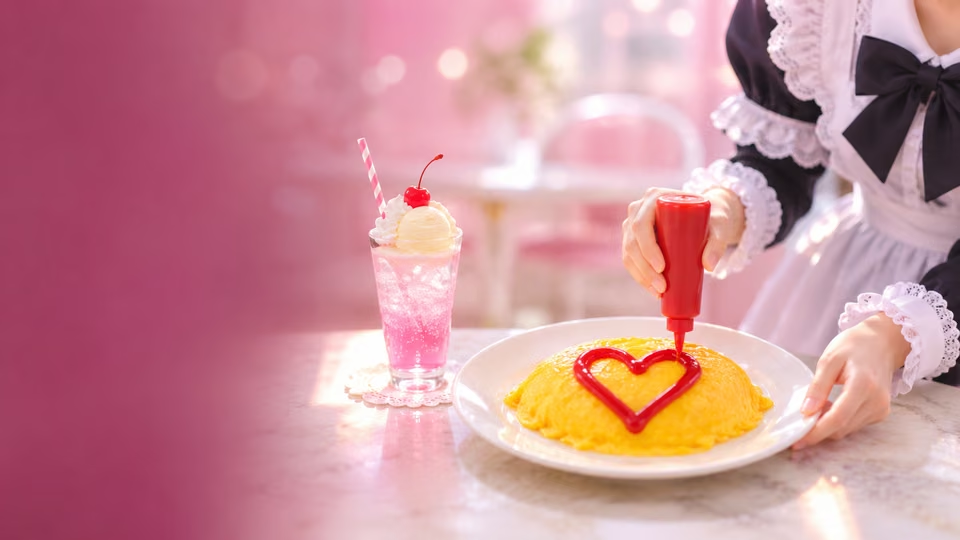
The original. Cast in maid uniforms greet you as goshujin-sama (master) or ojō-sama (my lady), draw on your omelette rice with ketchup, and lead a short chant to make the food "more delicious."
02.Butler and danso
Cafes aimed at female customers. In butler cafes, male cast in tailcoats serve tea with formal manners. In dansō cafes, the cast are women dressed as handsome men. Ikebukuro is the center for both.
03.Men's concept cafe
A newer category with young male cast serving mainly female customers, in themes from idols to princes. It sits between a butler cafe and a host club in atmosphere and price.
04.Idol
Cast perform songs and dances on a small stage between serving, and customers cheer with light sticks. Close to the world of underground idols.
05.Fantasy and horror
Vampires, witches, angels and devils, haunted hospitals, prisons. Interiors are elaborate and the cast stay in character throughout.
06.Costume themes
Nurses, shrine maidens, school uniforms, pajamas, kimono, bunny outfits, and many more. New themes appear constantly, and a district like Akihabara or Ikebukuro will have dozens at any time.
How a Visit Works
Entry and the system
At the door a cast member explains the system: the hourly charge, the order you must make, and the time limit. In Akihabara's larger maid cafes there is often an English menu or a laminated explanation card.
Seating and the first order
You are shown to a seat and asked to order at least one item per person per hour. In a cafe type that means a drink or a dish; in a bar type it is usually a drink set or all-you-can-drink.
Service in character
Your order arrives with whatever ritual the cafe has: a chant, a drawing in ketchup or chocolate, a short game. The cast will chat with you between serving other tables.
Optional extras
You can buy a cheki, an instant photo taken with a cast member and decorated by hand, or order a drink for the cast. Both are optional. Some cafes have a short stage show at set times.
Time's up
When your time is nearly over, the cast will ask whether you want to extend. Declining is normal. You pay at the register on the way out.
What It Costs
| Item | Cafe type | Bar type |
|---|---|---|
| Entry / table charge | ¥500–¥1,000 per hour | ¥1,000–¥3,000 per hour, often with all-you-can-drink |
| Required order | One drink or dish (¥600–¥1,500) | Included in the set, or one drink |
| Food | Omelette rice, curry, parfaits: ¥1,000–¥1,800 | Light snacks |
| Cheki (photo with cast) | ¥800–¥1,500 | ¥1,000–¥2,000 |
| Drink for the cast | Uncommon | ¥1,000–¥1,500 |
| Champagne and bottles | Rare | ¥10,000 and up |
| Typical total | ¥2,000–¥4,000 | Under ¥5,000 at most listed venues |
Rules You Are Expected to Follow
Concept cafes post their rules at the entrance or on the table, and they are enforced. They are much the same everywhere.
No touching the cast. No handshakes, hugs, or contact of any kind unless the cast member offers it as part of a paid cheki pose.
No photos of the cast or interior. Photographing your own food is fine. Any photo of a cast member is something you buy as a cheki.
No asking for personal contact details, real names, or where the cast live or study.
No waiting for cast outside the cafe before or after their shift.
One order per hour. The time limit and order rule are how the cafe makes its money; follow them without argument.
Breaking these rules gets customers removed and banned. They exist to protect the cast, many of whom are young, and to keep the experience comfortable for everyone.
Is It a Nightlife Venue? Is It Safe?
A daytime maid cafe is a themed restaurant. Families, couples, and solo travelers of all ages visit, and there is nothing adult about it.
A bar-type con-cafe is part of the night economy. The cast serve from behind a counter and are not supposed to sit with customers or provide the one-to-one hospitality that requires an entertainment license. Police in Tokyo and other cities have taken action against venues that crossed that line or employed underage staff, so the established cafes tend to be careful about their rules.
For a visitor, the practical cautions are the same as anywhere in Japanese nightlife: choose a venue in advance, ignore street touts (including cast handing out flyers for venues you have not looked up), and confirm the price before sitting. Customers must be 20 or older to drink alcohol. See the Kabukicho safety guide for how touting and overcharging work.
Where to Find Concept Cafes
01.Akihabara, Tokyo
The birthplace and still the largest concentration, from big multi-floor maid cafes with English menus to tiny themed bars. The best place for a first visit. See the Akihabara guide.
02.Ikebukuro, Tokyo
The east side around Otome Road is the center for butler cafes, dansō cafes, and men's concept cafes aimed at women, alongside many standard con-cafes. See the Ikebukuro guide.
03.Shinjuku and Kabukicho, Tokyo
Mostly bar-type venues open late, with darker and more elaborate themes. Prices run higher than Akihabara.
04.Osaka
Nipponbashi, known as Den Den Town, is Osaka's Akihabara and has the city's maid and concept cafes, with more in Minami. See the Osaka guide.
05.Other cities
Nagoya's Osu district, Fukuoka's Tenjin, Sapporo, Hiroshima, Kumamoto, and many regional cities now have their own con-cafes, usually bar-type.
Browse Concept Cafes on NightStyle
See real venues with photos, set prices, opening hours, and customer reviews. These are the listings Japanese customers use to choose where to go.
Listings are in Japanese. Your browser's built-in translation (Chrome, Safari, Edge) handles them well.
Words You Will Hear
- Konkafe (コンカフェ)
- Concept cafe. The everyday abbreviation.
- Kyasuto (キャスト)
- Cast: the staff, who serve in character.
- Goshujin-sama / Ojō-sama (ご主人様 / お嬢様)
- "Master" / "my lady." How maid cafe cast address customers.
- Okaerinasaimase (お帰りなさいませ)
- "Welcome home." The standard maid cafe greeting.
- Cheki (チェキ)
- An instant photo taken with a cast member, decorated by hand, and sold as a souvenir.
- Oshi (推し)
- Your favorite cast member, the one you come to support.
- Moe moe kyun (萌え萌えキュン)
- The chant performed over food in maid cafes to make it "delicious."
- Chāji (チャージ)
- The hourly entry or table charge.
- Wan ōdā (ワンオーダー)
- "One order": the rule that each customer orders at least one item per hour.
- Dansō (男装)
- Women dressed as men; a category of cafe popular with female customers.
- Enchō (延長)
- Extending your time.
Frequently Asked Questions
What is a concept cafe in Japan?
A concept cafe, or con-cafe, is a themed cafe or bar where costumed staff called cast serve customers in character. Themes include maids, butlers, idols, and fantasy settings. Customers pay an hourly charge plus what they order, and the main attraction is the atmosphere and conversation with the cast.
What is the difference between a maid cafe and a concept cafe?
A maid cafe is one type of concept cafe, and the original one. "Concept cafe" is the broader term covering every theme. In practice, maid cafes are usually daytime cafes serving food, while many newer con-cafes are evening bars serving alcohol.
How much does a maid cafe cost in Japan?
A typical maid cafe visit costs ¥2,000–¥4,000 per person: an entry charge of ¥500–¥1,000 per hour, at least one drink or dish, and an optional photo with a maid for ¥800–¥1,500. Set menus bundling these are common.
Can foreigners go to maid cafes and concept cafes?
Yes. Akihabara's larger maid cafes welcome tourists and often have English menus. Bar-type con-cafes also accept foreign customers, though little English is spoken, so a translation app helps.
Is there an age limit for maid cafes?
Daytime maid cafes generally admit all ages, including families. Bar-type concept cafes serve alcohol, and customers must be 20 or older to drink; some restrict entry at night to adults.
Are there concept cafes for women?
Yes. Butler cafes, dansō cafes where women dress as men, and men's concept cafes with male cast are all aimed mainly at female customers. Ikebukuro in Tokyo has the largest concentration.
Can I take photos in a maid cafe?
You can usually photograph your own food. Photos of the cast or the interior are not allowed. To get a photo with a cast member, you buy a cheki, an instant photo that the cast decorates for you.
What is a cheki?
A cheki is an instant-camera photo taken with a cast member, then decorated with pens and stickers and given to you as a souvenir. It typically costs ¥800–¥2,000 and is the standard paid extra at concept cafes.
Pick the Type
That Suits You
For a first visit, a large maid cafe in Akihabara in the afternoon is the easy choice: clear pricing, English support, and the full ritual. If you want to see how the format has grown into Japan's evening nightlife, try a bar-type con-cafe with a set price, for one hour.
For the neighboring formats, see girls bars by city, the Japanese snack bar guide, What Is Kyabakura?, and host clubs in Japan.